


Advertising with digital signage means using networked screens, LED displays and digital posters to show promotions, product videos and brand messages that you can change at any time, without reprinting anything. For South African businesses, it offers a flexible way to reach customers at your premises, along busy roads and inside shopping centres, with content that adapts to the time of day, the season or the stock on your shelves.
This guide explains where digital screens earn their place, which formats suit different locations, how to plan content that people actually notice, and how to measure whether the investment pays back.
Why Digital Signage Works as an Advertising Channel
Digital signage works because moving, changeable content attracts attention in places where static signs go unnoticed, and it lets you change the message without a new production run.
The wider industry trend supports this. According to the Out of Home Advertising Association of America, US out-of-home advertising revenue reached $9.46 billion in 2025, and digital formats grew strongly over the same year. The figures are American, but they show where advertisers are directing budgets: towards screens that can be updated instantly and scheduled by the hour.
The practical advantages for a local business are straightforward:
- Speed of change. A weekend special can go live on Friday morning and disappear on Monday.
- Scheduling. Breakfast offers can give way to lunch deals automatically.
- Consistency. One central update can refresh screens at every branch, from Johannesburg to Cape Town.
- Lower long-term print costs. Once the hardware is installed, new campaigns do not require new vinyl, boards or posters.
- Motion and light. Screens remain visible at dusk and in dim interiors, where printed signs lose impact.
A printed sign still has its place. A well-made fascia, pylon or neon sign establishes permanent brand recognition. Digital screens add the changeable layer on top of it.
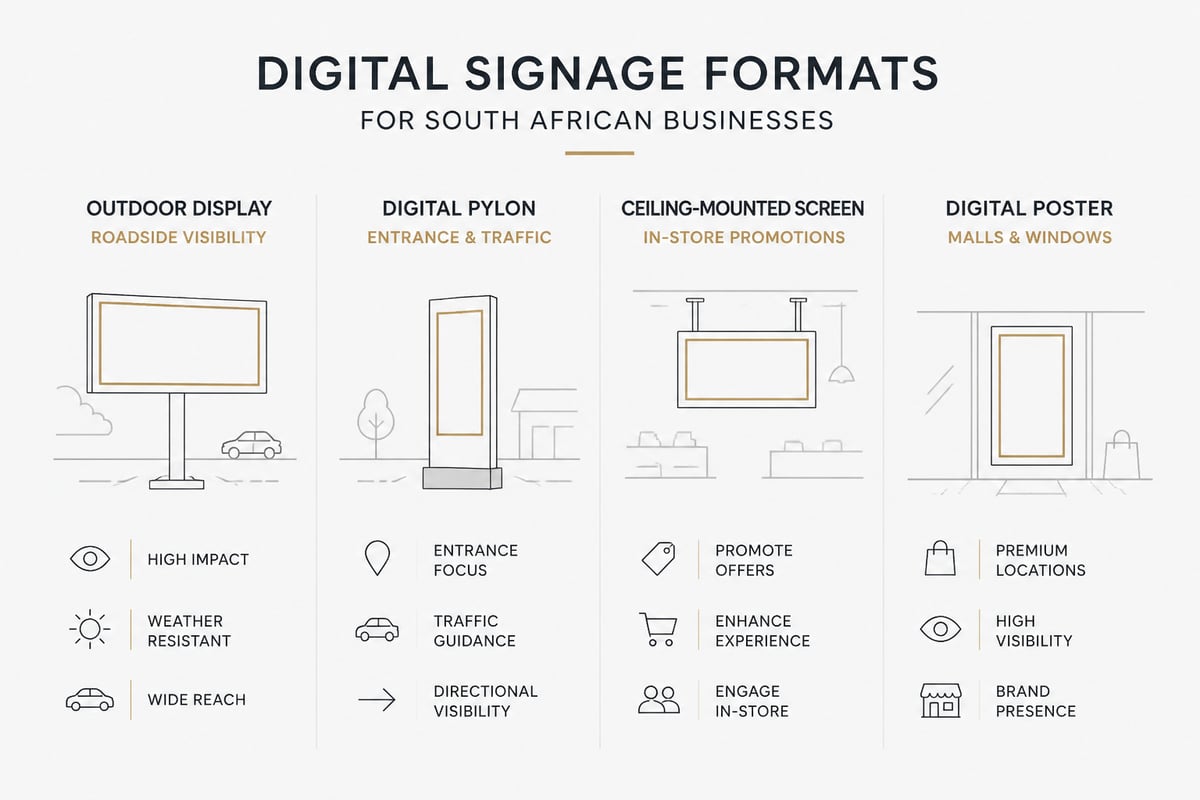
Types of Digital Signage for Advertising
The right format depends on where customers will see it and how long they will look at it, so match the screen to the viewing situation before choosing a size or specification.
Outdoor and roadside displays
For businesses on busy routes, such as petrol stations, dealerships and restaurants, outdoor units must cope with direct sunlight, dust, heat and rain. High-brightness weatherproof screens are designed for this, and Signshoponline lists outdoor digital signage and digital billboards for roadside and large-scale visibility.
Digital pylons
A pylon is often the first thing a driver sees. Replacing a static panel with a screen lets a shopping centre or service station advertise tenant offers, fuel specials or event dates on the same structure. See the range of digital display pylons for options that combine permanent branding with changeable content.
In-store and ceiling-mounted screens
Inside a shop, screens work best where customers wait or browse slowly: tills, queues, aisle ends and entrance areas. Ceiling-mounted digital signage keeps floor space clear and gives staff a flexible way to feature promotions above head height.
Digital posters and advertisement displays
Portrait-format digital posters suit malls, reception areas and shop windows. Larger digital advertisement displays suit venues that need to carry several messages in rotation.
Where to Place Screens for the Best Return
Place screens where your target customer already stops, waits or slows down, because dwell time determines how much of your message gets read.
Consider these high-value locations:
- The storefront or window. This turns passers-by into visitors. Keep messages short, with one offer and one clear call to action.
- The entrance or reception. Welcome messages, opening hours, event announcements and service menus work well here.
- Queues and waiting areas. People have time to read, so longer messages and short videos are appropriate.
- Point of sale. Impulse items, add-on services and loyalty offers sit naturally at the till.
- Roadside or car park frontage. Vehicles move quickly, so use large type, high contrast and no more than seven or eight words.
A common planning mistake is to install screens at eye level in a location with no dwell time, such as a narrow corridor. If people cannot pause, the content cannot work, however good the creative is.
Content That Holds Attention
Effective screen content is short, high-contrast and built around a single message per slide, because viewers give a screen only a few seconds.
Practical rules for creating content:
- One idea per slide. Offer, price, call to action. Nothing more.
- Large, readable type. If you cannot read it from the furthest viewing point, enlarge it.
- Motion with purpose. Use movement to draw the eye to the key element, such as a price or a date, rather than animating everything.
- Brand consistency. Use the same logo, colours and typefaces found on your fascia and vehicles so screens reinforce recognition. A brand audit is a useful starting point for checking that your signage speaks with one voice.
- Timed relevance. Show hot-meal specials at lunchtime and winter stock in May. South African seasonality, load-shedding schedules and public holidays all create timely content hooks.
A simple content mix
A balanced loop for a retail screen might include roughly half product or promotion slides, a quarter brand or service messages, and a quarter useful information such as opening hours, events or payment options. Adjust the proportions based on what customers respond to.
Combining Digital Screens with Other Signage
Advertising with digital signage delivers the strongest results when screens sit within a wider signage plan rather than replacing everything else.
Think of the layers:
- Permanent identity: fascia signs, illuminated signage and neon branding that stay the same and build recognition.
- Changeable messaging: screens for offers, events and updates.
- Mobile reach: vehicle signage that carries your brand through traffic all day.
- Event and temporary activity: banners and printed displays for launches and promotions.
Neon deserves a specific mention. A neon sign beside a screen gives a premium, atmospheric feel that screens cannot replicate, and it works well in restaurants, bars and boutique retail. Neon signs need lead time for production, so factor that into launch dates when you plan a combined installation.

How to Measure the Results
Measure digital signage by setting a clear goal before launch, comparing sales or enquiries against a baseline, and reviewing the results on a fixed schedule.
Audience measurement in digital out-of-home is a developing discipline. The IAB's 2025 DOOH measurement guide describes how impressions are estimated using factors such as display location, orientation, audience movement and the likelihood of exposure. The same guide identifies synthetic control groups and matched-market testing as approaches for measuring campaign attribution. A single-site business does not need that level of sophistication, but the principle carries over: compare places with screens to similar places without them, or compare periods before and after.
Practical measures for a South African business include:
- Sales lift on promoted items compared with the same weeks before the screen went live.
- Redemption codes or phrases. Ask customers to mention the screen offer, or use a unique code.
- Footfall or enquiry counts at the premises.
- Dwell and conversion at tills where screens promote add-ons.
- Staff feedback on how often customers ask about something they saw on screen.
Review every month for the first quarter. Retire slides that do not perform and build more of the ones that do.

Planning and Budgeting Your Rollout
A sensible rollout starts with one or two well-placed screens, proves the concept, and then expands, rather than fitting every wall at once.
Steps to follow
- Define the goal. Increase walk-ins, sell more of a specific line, promote events, or reduce perceived waiting time.
- Audit your premises. Note viewing distances, ambient light, power access and mounting surfaces. Consider security as well, especially for outdoor units.
- Choose the format. Indoor, outdoor, pylon, poster or ceiling-mounted, depending on the earlier analysis.
- Plan power resilience. In South Africa, load-shedding affects screen uptime. Discuss backup power or inverter options with your supplier so that your display does not go dark when customers are around.
- Prepare content before installation. Have the first month of slides ready so that screens are useful from day one.
- Set a content owner. Assign one person to update and review content regularly. Neglected screens showing last season's offer harm credibility.
- Check local rules. Roadside and outdoor displays may need municipal approval depending on size, position and brightness, so confirm requirements with your local authority before installation.
For multi-branch businesses, project management and national project rollouts help keep screens, mounting and branding consistent from site to site.
What affects cost
Pricing varies with screen size, brightness rating, weatherproofing, mounting method, content management software and installation complexity. Rather than guessing, request a quote based on your site, and ask the supplier to explain which specification is genuinely needed for your location. Signshoponline advises on the best materials and production methods whether you need one sign or several hundred.
If funding the hardware is the sticking point, a business may look at financing options such as those from Revlendr, which provides flexible small business loans, or speak to its bank about equipment finance. Keep the screens connected and secure as well: businesses running networked displays across several sites often rely on managed providers such as Always Beyond for IT support and cybersecurity.
Common Mistakes to Avoid
Most digital signage problems come from planning and upkeep rather than from the technology itself.
- Too much text. If a slide needs more than a few seconds to read, split it.
- Poor contrast. Light grey text on white, or thin fonts over busy photographs, disappears in sunlight.
- Wrong brightness. An indoor panel in a sunlit window will look washed out. Use a display rated for the conditions.
- No content schedule. Screens left on a single loop for months teach customers to ignore them.
- Ignoring the rest of the brand. Screens that look unrelated to the shopfront confuse recognition. Keep colours and logos consistent, and consider how a logo on your sign drives business.
- Treating digital as a replacement. Static and digital signage do different jobs. Use both deliberately.
Frequently Asked Questions
Is digital signage worth it for a small business?
Yes, where the screen sits in front of customers who are already close to buying. A single well-placed display at a till, window or entrance can pay back by promoting higher-margin items or services, and it removes the recurring cost of reprinting promotional posters.
How often should I update screen content?
Review weekly and refresh the main promotions at least monthly. Time-sensitive content, such as daily specials or event dates, should change as often as the offer does.
Can digital signage work outdoors in South African conditions?
It can, provided the display is built for outdoor use, with adequate brightness, weather sealing and heat management. Specify the unit for its exact location rather than adapting an indoor screen.
What is the difference between digital signage and a digital billboard?
Digital billboards are large-format displays aimed at passing traffic over longer distances. Digital signage is the broader category and includes smaller in-store, window and poster screens designed for closer viewing.
Your next step is to walk your premises at a busy time, note where customers pause, and sketch where a screen would catch their attention. Once you have that rough plan, Signshoponline can advise on the right screens, materials and mounting for your site, so get a quote from Signshoponline and have your first display specified correctly.


