


LED signage uses light-emitting diodes to illuminate lettering, logos or full-colour screens, so that a business is visible day and night with low power consumption. The right choice depends on three things: what you want to display, how far away your audience stands, and where the sign will be mounted. This guide explains the main types, the technical specifications that matter, and how to match a sign to a shopfront, restaurant, bar or home.
What LED Signage Includes and How It Works
LED signage is an umbrella term covering any sign lit by diodes, from a simple illuminated shop name to a programmable video display. The diodes are small, produce little heat and last far longer than the fluorescent tubes and incandescent bulbs they replaced.
In practice, buyers meet five broad categories:
- Illuminated lightboxes: a box-shaped sign with LEDs behind a printed or cut face.
- Channel letters and halo-lit lettering: individual letters with LEDs inside or behind them.
- LED neon-style signs: flexible LED strip shaped into script or artwork.
- Moving or scrolling message signs: single or multi-colour displays for text and simple animations.
- Full-colour LED screens: pixel-based displays for video and changing content.
Accessibility Standards Canada recommends LED display technologies as an option that economises on electricity consumption. That matters in South Africa, where load shedding and rising tariffs make running costs a genuine part of the buying decision.
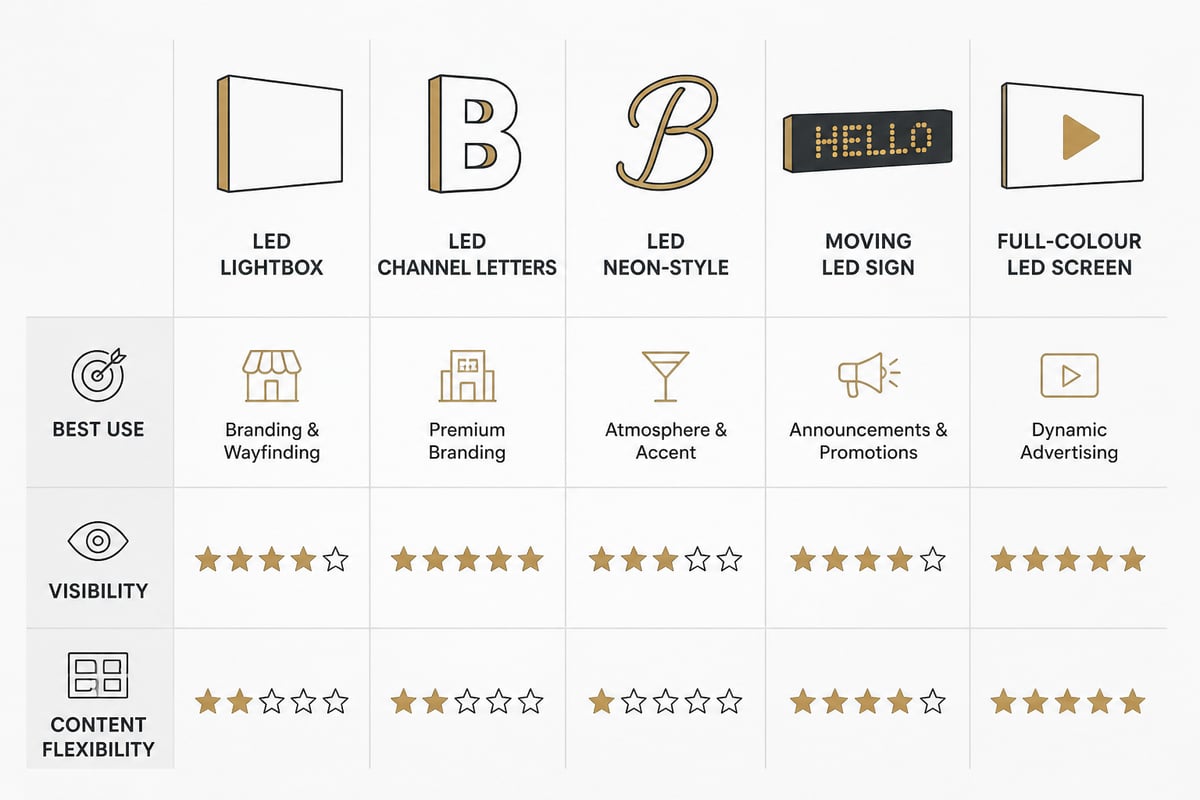
Types of LED Signage Compared
Each type of LED sign suits a different job, so the comparison below sets the common options against the attributes buyers weigh most.
| Type | Best use | Visibility | Content flexibility | Typical setting |
|---|---|---|---|---|
| Lightbox | Shop fascia, directional signage | Strong day and night | Fixed (face can be replaced) | Retail, offices |
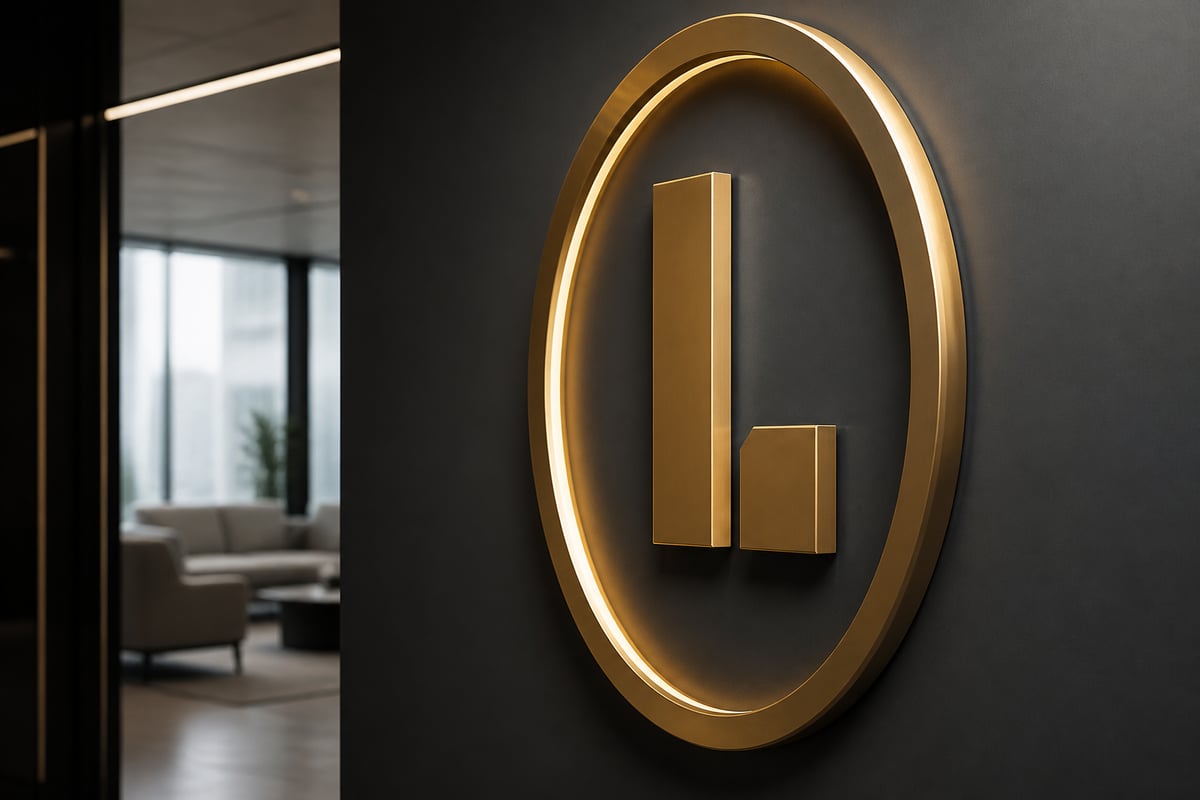
| Channel or halo letters | Premium building identity | Strong at night | Fixed | Corporate premises |
| LED neon-style sign | Atmosphere, decor, branding | Moderate, close range | Fixed | Bars, restaurants, homes |
| Moving LED sign | Specials, opening hours, promotions | High | Changeable text | Windows, counters |
| Full-colour LED screen | Video and rotating adverts | Very high | Fully changeable | Larger premises, events |
Fixed signs reward you with simplicity and durability. Changeable signs reward you with relevance, since a restaurant can update a daily special in minutes. For businesses weighing the second route, Signshoponline's notes on marketing a brand with LED sign displays cover how displays support promotional campaigns.
Many premises combine two types rather than choosing one. A clinic might fit a lightbox above the entrance for permanent identification and a moving sign at reception for opening hours. A bar might pair an exterior illuminated name with a neon-style piece behind the counter. The table also shows a pattern in range: lightboxes and channel letters are read from a distance, neon-style signs are read at close range, and screens sit at the top of the scale for reach but also demand the most attention to pixel pitch, brightness and content planning.
Lightboxes: The Dependable Choice for Shopfronts
A lightbox is the most practical illuminated sign for a business that needs a clear, consistent identity above its door or on its pylon. The face is evenly lit from behind, which gives brand colours a uniform glow and makes the name readable from a passing car or across a car park. Because the light source sits inside a sealed box, the face looks the same at 2pm as at 8pm, and the sign continues to advertise the premises after the shop has closed.
Signshoponline manufactures illuminated lightboxes with a choice of Mae-West or acrylic returns, which suits shopfronts, offices and roadside premises that need reliable all-hours presence. The return is the side wall of the box, so the choice affects the profile and finish of the sign as seen from an angle, which matters on a fascia viewed along a pavement. You can view the options on the Lightbox Signage page.
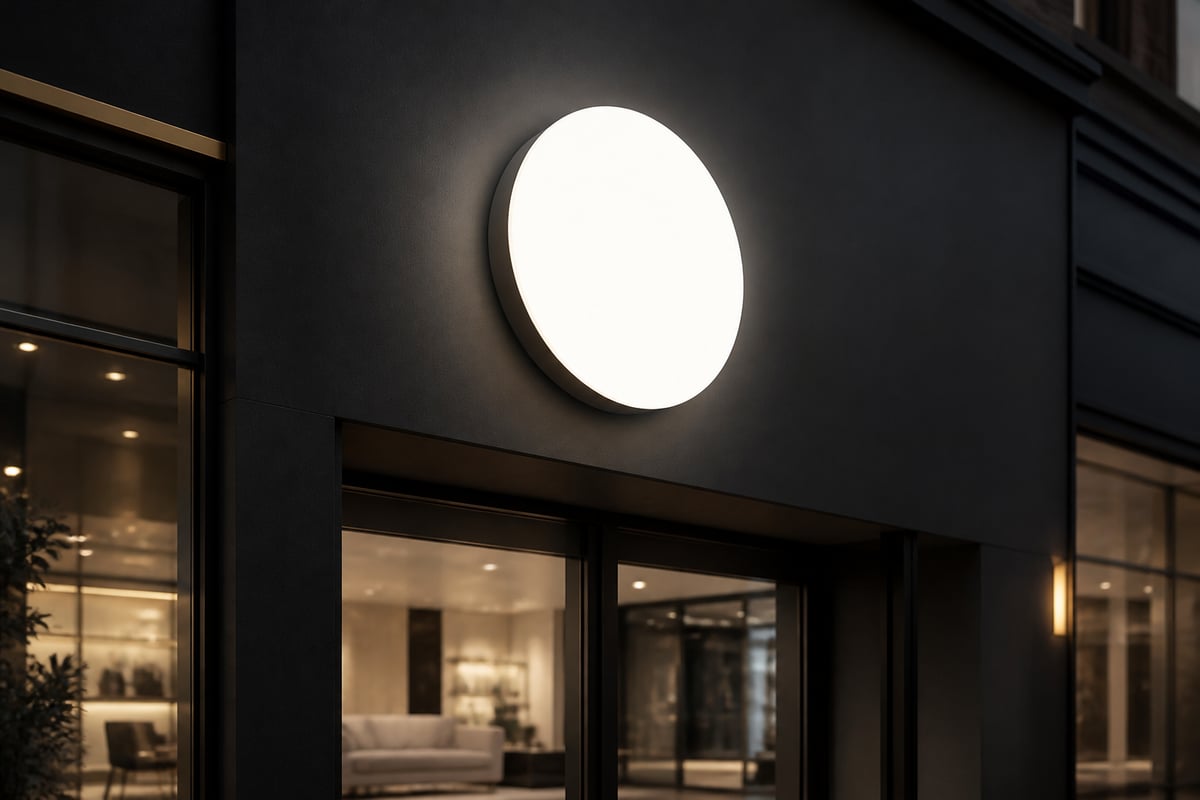
Faces can be reprinted when branding changes, which spares you the cost of replacing the whole structure. A business that updates its logo, adds a new service line or changes its tagline only needs a new face fitted to the existing box. Placement matters too. A fascia lightbox is read at street level, whereas a pylon version serves drivers approaching from further away. Many premises use both, with the pylon announcing the business from the road and the fascia confirming the entrance once visitors arrive.
LED Neon Signs for Bars, Restaurants and Homes
LED neon-style signs deliver the warm, handmade look of glass neon with sturdier construction and lower power draw. They are shaped from flexible tubing, which allows script lettering, logos and illustrations in a wide colour range.
For hospitality venues the appeal is atmosphere. A glowing sign behind a bar or beside a dining area becomes a backdrop that guests photograph and share. For home owners the same product works in a lounge, games room or home bar, where it acts as lighting and artwork at once.
Practical points to settle before ordering:
- Size: measure the wall and allow clear space around the sign so it does not feel crowded.
- Colour: warm white and amber suit relaxed venues, while saturated blues and pinks suit lively ones.
- Mounting: wall-hung versions need a solid fixing, and window versions should face the street.
- Environment: indoor signs are not built for rain, so outdoor positions need a weather-rated build.
Check Signshoponline's current turnaround times for neon signs before you order, which helps if you are working to a venue opening or a seasonal trading period.
Moving and Programmable LED Signs
Moving LED signs display scrolling or flashing messages and suit businesses whose offers change often. A butchery advertising weekend specials, a pharmacy showing opening hours or a car dealer highlighting stock can all update text without reprinting anything. That ability to change the message in minutes is the main reason a business chooses this format over a fixed sign, because the cost of a new printed face or replacement panel disappears from every campaign.
These signs draw the eye through motion, which makes them effective in windows and at counters where footfall is high. Keep messages short, because readers will take in only a handful of words as they walk past. A line such as "Fresh bread from 6am" works at a glance, whereas a full paragraph of terms and conditions will scroll past unread. Colour choice matters as well: high-contrast text on a dark background stays legible in bright shopfront glazing, and limiting a message to one or two colours avoids a cluttered look.
Placement affects results more than most buyers expect. A sign mounted at eye level just inside the glass reaches pedestrians, while one hung higher serves people queuing or waiting. Signs that sit behind reflective glass need to be angled or recessed so that daytime glare does not wash out the display. Businesses running several outlets can also benefit from central control, so that a price change or promotion appears on every sign at once. Signshoponline's range of moving LED signs shows the formats available, and the article on digitally controlled advertising explains how remote content control works for businesses managing several displays.
Pixel Pitch: The Specification That Decides Image Quality
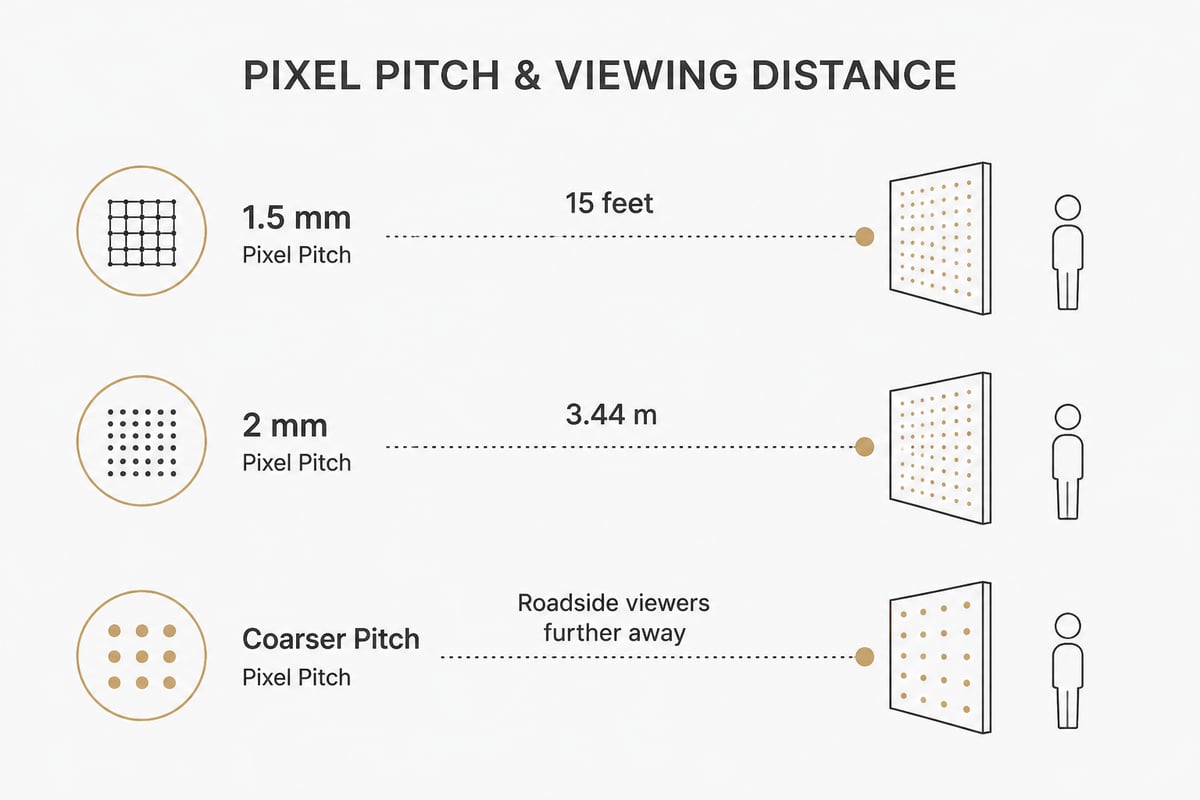
Pixel pitch is the centre-to-centre distance between adjacent LED pixels, measured in millimetres, and it determines how sharp a screen looks from a given distance. AVIXA explains that a smaller pitch supports closer viewing and higher image detail, while generally increasing cost.
Two rules of thumb help you size a screen:
- AVIXA's approximate average comfortable viewing distance is 30 times the pixel pitch, so a 2 mm pitch corresponds to about 3.44 m.
- Christie Digital cites a quick estimate of 10 feet of viewing distance per millimetre of pitch, so a 1.5 mm pitch suits about 15 feet.
The two methods differ because they assume different standards of comfort, so treat both as starting points rather than fixed limits. The principle is consistent: viewers standing close need a fine pitch, and viewers across a road can be served by a coarser, cheaper one. Paying for a pitch finer than your audience can perceive is wasted budget.
Brightness, Visibility and Energy Use
Brightness should be matched to the surroundings, because an indoor level looks washed out in direct sunlight and an outdoor level is glaring in a dim restaurant. South African sunshine is a real factor for any sign facing east or west, so outdoor screens need substantially higher output than indoor ones.
Accessibility Standards Canada specifies at least 200 lx on the sign surface for illuminated signs covered by its guidance, measured uniformly across the face. It also recommends digital signage brightness that adjusts automatically to local light conditions, rather than relying on a preset schedule or user-defined setting. Automatic dimming prevents glare at night and keeps content legible at midday.
The standards are Canadian, and the U.S. Access Board notes that the ADA Standards do not specify illumination levels at or on signs. They are useful as benchmarks rather than South African requirements, so confirm local by-law and landlord rules before you install anything on a street frontage.
Matching a Sign to Your Premises, Vehicle or Event
Start with the viewing situation, then choose the product. A few common pairings:
- Shopfront on a busy road: a fascia or pylon lightbox for permanent identity, plus a moving LED sign in the window for offers.
- Restaurant or bar: an LED neon-style sign inside for atmosphere, and an illuminated name sign outside to guide arrivals after dark.
- Home entertainment area: a custom neon-style sign sized to the wall.
- Events and exhibitions: lightweight illuminated displays that travel well and can be set up quickly.
Power supply deserves attention in Gauteng, Durban and Cape Town alike. Signs on a timer or with automatic dimming use less energy, and low-wattage LEDs keep running costs predictable. Backup power is worth considering for venues that trade through outages, and portable power stations are one option some businesses explore for small signs and displays. Veridion Dynamics sells power stations, which gives an idea of what such equipment looks like.
Questions to Settle Before You Order
A short checklist prevents most costly mistakes:
- How far away is your typical viewer, and for how long are they in view?
- Will the sign be indoors, outdoors or in a window?
- Does the content stay fixed or change often?
- What mounting surface and power access are available?
- Do you need landlord or municipal approval?
Each answer shapes the specification. Viewing distance and dwell time point to a pixel pitch or letter height: a driver passing at speed needs large, simple lettering, while a diner seated two metres from a wall can appreciate fine detail. The indoor, outdoor or window question decides the build, since weather exposure and direct sunlight call for a rated enclosure and higher brightness. Fixed content favours a lightbox or neon-style sign, while frequent changes favour a programmable display.
Mounting and power are practical limits that are easier to settle before manufacture than after. A masonry wall, a glass window and a steel pylon each need a different fixing method, and a cable run that is not planned can add cost on installation day. Approval deserves an early conversation too, because a landlord's lease conditions or a municipal by-law can restrict size, illumination or position on a street frontage.
Signshoponline is a full-service signage company that specialises in creating and supplying custom signs, and it advises on the best materials and production methods whether you need one sign or several. For specifics such as sizes, quantities and pricing, check the product pages or the contact page rather than relying on assumptions.
Before contacting anyone, write down your viewing distance, mounting position and whether the message will change, since those three answers narrow the choice quickly. Signshoponline can then advise on materials and production and manufacture anything from a single lightbox to a full set of illuminated signs. Browse the Lightbox Signage range for a fixed illuminated option, then get a quote from Signshoponline for the sign that suits your premises.


