


Backlit signage is a sign lit from behind or from within, so that light passes through the face or glows around the lettering, making your business visible after dark. The main options are lightboxes, halo-lit letters and LED-backlit panels, and each suits a different budget, building and brand style. This guide explains how they work, what influences the price, which materials to choose and how to design a sign that stays legible from the street.
What Is Backlit Signage and How Does It Work?
Backlit signage places a light source, usually LED modules, behind a translucent or cut-out face so the light either shines through the material or washes onto the wall behind it.
The word "illuminated" is the broader term. It covers any sign that carries its own light, including front-lit channel letters and spotlit boards. Backlit signs are one subset, defined by the light travelling away from or through the face rather than shining onto it.
Three construction principles cover most products:
- Face-lit (through-lit): light passes through an opal acrylic or vinyl-covered face, so the whole panel or letter glows.
- Halo-lit (reverse-lit): the letters are solid and opaque, with LEDs shining backwards onto the wall to create a soft ring of light around each character.
- Combination: a face-lit logo with halo-lit lettering, or a lightbox with a push-through layer of raised acrylic.
LED has replaced fluorescent tube in almost all new work. It draws less power, lasts longer and allows thinner cabinets. The lower consumption also helps when running on a small backup supply, since a sign uses far less than older lighting.
Types of Backlit Signage Compared
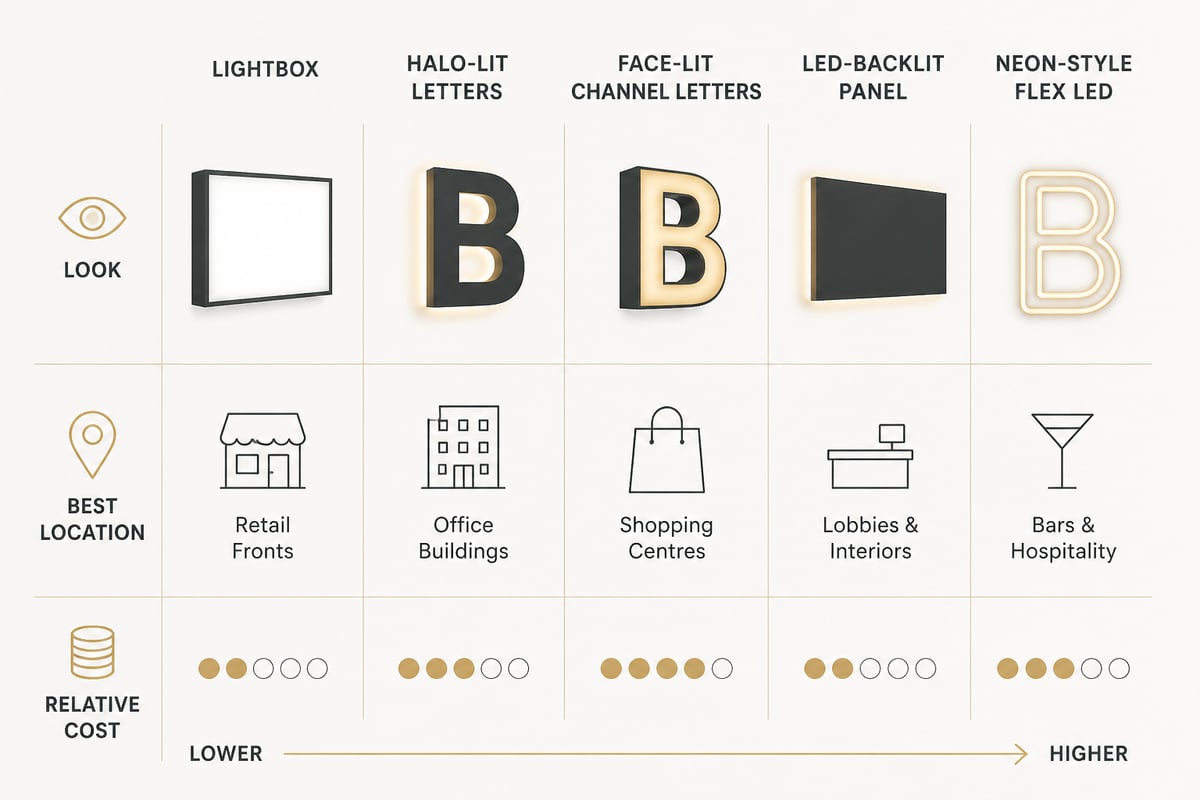
The right type depends on the building, the viewing distance and how much brand detail you need to show. The table below sets out the main options side by side.
| Type | How it looks | Best location | Relative cost |
|---|---|---|---|
| Lightbox (flat or Mae-West) | Evenly glowing panel with printed or vinyl graphics | Shopfronts, pylons, fascias | Low to medium |
| Halo-lit 3D letters | Solid letters with a glow around the edge | Premium retail, offices, restaurants | Medium to high |
| Face-lit channel letters | Individually glowing letters | Long fascias, shopping centres | Medium to high |
| LED-backlit panel | Slim, edge-to-edge illuminated graphic | Interiors, menu boards, reception walls | Medium |
| Neon-style flex LED | Bright tube-style lettering | Bars, restaurants, home entertainment areas | Low to medium |
Lightboxes
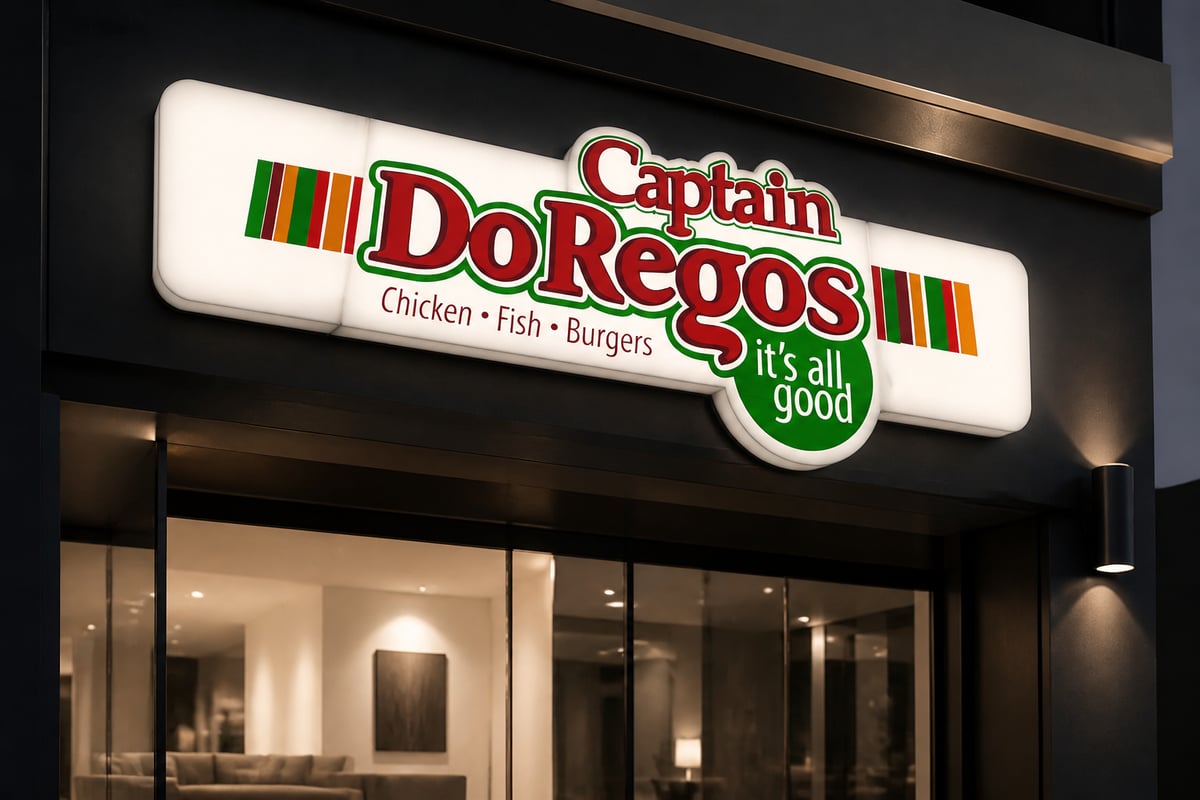
A lightbox is a sealed cabinet with an LED-lit translucent face. It is the most economical way to get a bright, uniform sign, and it handles full-colour logos well. Signshoponline manufactures illuminated lightboxes in two formats: Mae-West, which has a rounded profile, and acrylic returns, which give a cleaner, more modern edge.
Halo-lit letters
Halo lighting suits brands that want a restrained look. The letters stay dark by day and glow softly at night, which many professional practices, boutiques and upmarket restaurants prefer. The effect depends on the wall behind, so a smooth, light-coloured surface reflects the glow far better than rough face brick.
Face-lit and channel letters
Each letter is a shallow tray with an acrylic face and LEDs inside. Letters can be spaced across a long frontage without a connecting panel, which suits shopping centre units where the fascia is wide and low.
Neon-style and decorative signs
For bars, restaurants and home entertainment spaces, flexible LED neon gives the classic tube look without glass. It is lighter and easier to hang than glass neon, and it works well as a feature wall piece rather than a primary shopfront sign.
How Much Do Backlit Signs Cost?
Backlit signs cost anywhere from a few thousand rand for a small lightbox to well over R50,000 for large custom channel lettering, and the figure depends on size, construction and installation rather than a fixed rate per square metre.
Treat any single price you see online as an indication only. The factors that move a quote most are:
- Size and depth. Larger faces need more LEDs, stronger frames and heavier mounting.
- Construction type. A printed lightbox face is cheaper than individually fabricated 3D letters.
- Materials. Aluminium returns cost more than painted steel, and thicker acrylic costs more than thin sheet.
- Lighting specification. Dimmable or colour-changing LEDs add to the price.
- Location and access. A first-floor fascia needing a cherry picker costs more than a ground-level wall.
- Electrical work. Running a new supply or installing a transformer is usually quoted separately.
- Compliance and approvals. Drawings or council submissions add time and sometimes fees.
The most reliable way to compare options is to give every supplier the same brief: dimensions, a photo of the wall, the artwork and whether power is already available. Signshoponline offers manufacturing, installation and design services, and its team can advise on materials and production methods whether you need one sign or several. For pricing on your specific job, use the lightbox signs page or contact the business directly.
What Material Is Used for Signage?
Most backlit signs combine an aluminium or steel frame with an acrylic or polycarbonate face, and the choice of each material governs durability, weight and appearance.
- Acrylic (perspex): the standard for translucent faces. It diffuses light evenly and cuts cleanly into letters, though it can scratch and may yellow under years of strong UV if low quality.
- Polycarbonate: tougher than acrylic and better for locations where impact is likely, such as street-level pylons.
- Aluminium: light, corrosion resistant and ideal for coastal sites such as Durban and Cape Town, where salt air attacks untreated steel.
- Stainless steel: used for premium halo-lit letters and entrance features.
- Printed vinyl and translucent film: applied to the face to carry colours and logos while still letting light through.
- Flex LED neon sleeve: a silicone or PVC channel that diffuses the light for neon-style work.
For pylons and large roadside units, see the pylon signage range, which suits businesses that need visibility from passing traffic rather than only from the pavement.
Do You Need Planning Permission for Illuminated Shop Signage?
In most South African municipalities you need approval before erecting an illuminated sign, because outdoor advertising is regulated through municipal by-laws rather than a single national rule.
Requirements differ between the City of Johannesburg, eThekwini, Cape Town and smaller towns. Typical points a council may assess include:
- the size and projection of the sign over a public pavement
- the height above ground and distance from road junctions
- whether the sign flashes, scrolls or changes colour, which is often restricted near roads
- heritage or conservation area controls
- landlord or shopping centre consent, which is frequently required even when council approval is not
Check with your local municipality and your landlord before ordering, and ask your sign supplier what drawings they can provide to support an application. Internal signs, such as those inside a restaurant or bar, normally fall outside these rules, though building and electrical safety requirements still apply.
Design Tips for Backlit Signs That Read Well at Night
A backlit sign reads well when it has strong contrast, restrained colour, simple letterforms and the right brightness for its surroundings.
Prioritise contrast
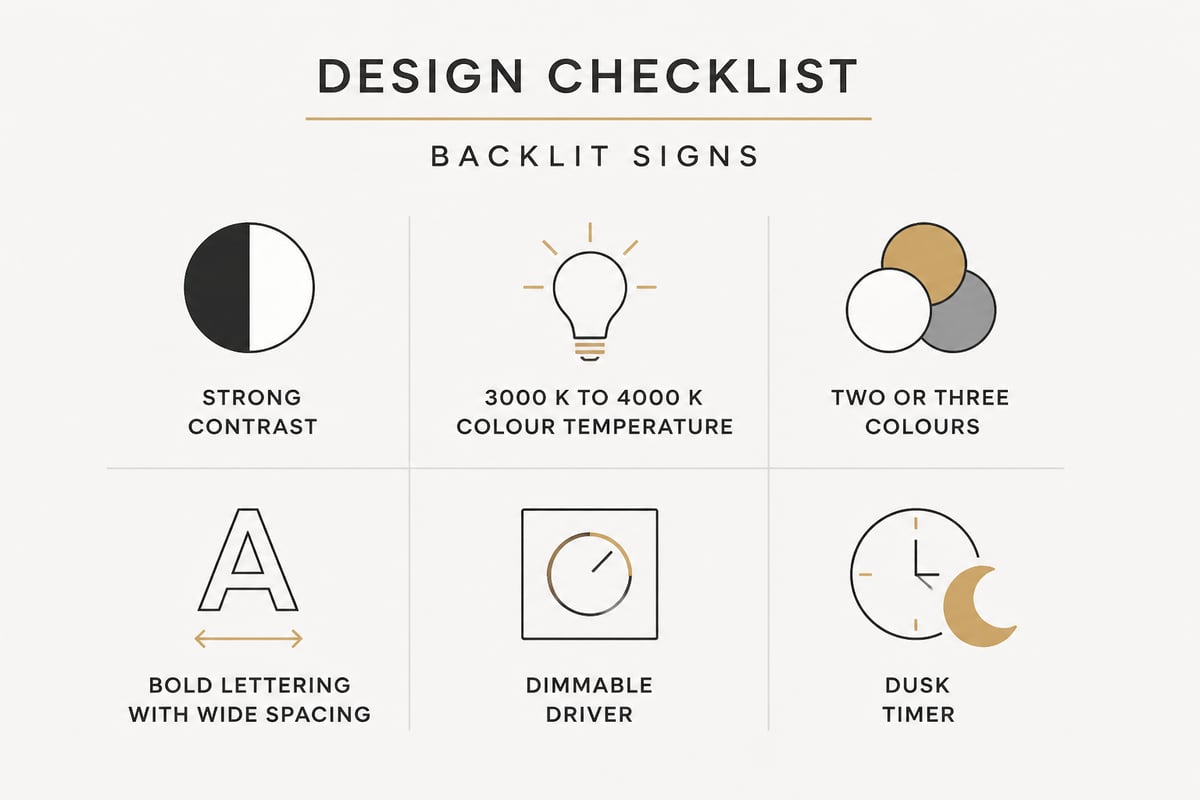
Contrast between letters and background does more for legibility than any other choice. The ADA Standards require visual characters to contrast with their background, either light on dark or dark on light, but they do not specify sign illumination levels. The principle carries over to commercial signage everywhere. A white glowing logo on a dark face reads at distance far better than a pale blue on grey.
For outdoor vertical signs, Canadian guidance goes further, recommending at least 70% luminance contrast with the surroundings, including the mounting elements, as set out in the Government of Canada's lighting and contrast guidance. Use it as a benchmark when judging a mock-up against your brickwork or cladding.
Choose the right colour temperature
The same Canadian guidance recommends a colour-rendering value above Ra 80 and a colour temperature around 3000 K for lighting design. For commercial signs, warm white at about 3000 K feels inviting for restaurants and hospitality, while cooler whites make retail and corporate branding look crisp. Avoid mixing LED batches with different colour temperatures on one sign, as the mismatch is visible at night.
Keep the artwork simple
- Use bold, sans-serif lettering for primary names.
- Leave generous space between letters, since light bleeds and tight spacing blurs.
- Limit the face to two or three colours.
- Avoid fine hairlines and small taglines, which disappear when lit.
Match brightness to the setting
An over-bright sign in a quiet residential street looks harsh and may attract complaints. A dim sign in a busy retail strip disappears. Ask for a dimmable driver so the output can be set after installation, and consider a timer or photocell so the sign switches on at dusk without anyone remembering.
Backlit Signage for Bars, Restaurants and Homes
Hospitality venues and homeowners tend to use backlit signage as decor as much as identification, so the priority shifts from legibility at distance to atmosphere and craft.
A restaurant might combine an external halo-lit name with an internal feature wall, such as a neon-style logo behind the bar or a lit menu panel. Because these pieces are viewed close up, finish quality matters: clean edges, even glow without visible LED dots and consistent colour. Neon-style signs and custom LED pieces for these uses are among the products Signshoponline offers.
At home, a lit sign works in a games room, a man cave, a home bar or a braai area. Safety is simple to manage: low-voltage LED, sealed drivers and an indoor or outdoor rating that matches the location. If you are putting together a space for entertaining, a personal touch such as grooming products for guests, perhaps from a specialist like MijnBaard, pairs naturally with a well-lit bar corner, though the sign itself should remain the centrepiece.
Installation, Power and Maintenance
A backlit sign is only as reliable as its power supply and fixings, so plan both before the design is approved.
Check these points with your installer:
- Power access. Confirm where the supply will come from and whether a new circuit is needed.
- Weatherproofing. Outdoor signs need sealed cabinets and an appropriate IP rating, particularly in the Highveld's summer storms and coastal humidity.
- Fixings. Wall type determines the bracket, whether face brick, plaster, cladding or glass.
- Surge protection. A surge protector guards the drivers against grid spikes.
- Access for servicing. LED drivers occasionally fail, so a hinged or removable face saves cost later.
For maintenance, wipe acrylic faces with a soft cloth and mild soapy water, avoiding solvents that craze the surface. Inspect seals once a year, and check for dead LED modules if the glow looks patchy. Well-made LED sections typically run for years before needing attention.
Backlit signs also work alongside other signage. Many businesses pair a lit fascia with an interior LED backlit display and, for road-facing premises, a backlit billboard. The business's own article on why backlit signs suit a business covers the brand-visibility case in more detail.
FAQ
What does "illuminated signage" mean?
Illuminated signage is any sign that has its own light source, whether the light shines through the face, around the letters or onto the surface. Backlit, halo-lit, face-lit and spotlit signs all fall under the term.
Are backlit signs expensive to run?
Modern LED backlit signs draw very little power, typically far less than older fluorescent lighting. Running cost is usually minor next to the cost of manufacture and installation.
How long does a backlit sign last?
A well-built sign with quality LEDs and a sealed cabinet can last many years. Lifespan depends on the LED grade, the weather exposure and whether the power supply is protected against surges.
Start by photographing your shopfront or feature wall at night and measuring the available space, since those two details let any supplier give you a meaningful quote. Signshoponline can then advise on the right construction, from a lightbox to halo-lit lettering, and handle the design and installation. Get a quote from Signshoponline and have your signage specified before you commit to a build.


