


Construction signage is the set of safety, warning, directional and informational signs that controls how people and vehicles move around a building site, and it should be placed where hazards can be seen and understood before anyone reaches them. A well-planned set of signs protects workers and the public, supports legal compliance and shows visitors that the site is professionally run. This guide explains the main sign types, the colour and size conventions, the rules that apply and the placement logic that makes a sign set work.
What types of safety signs are displayed on construction sites?
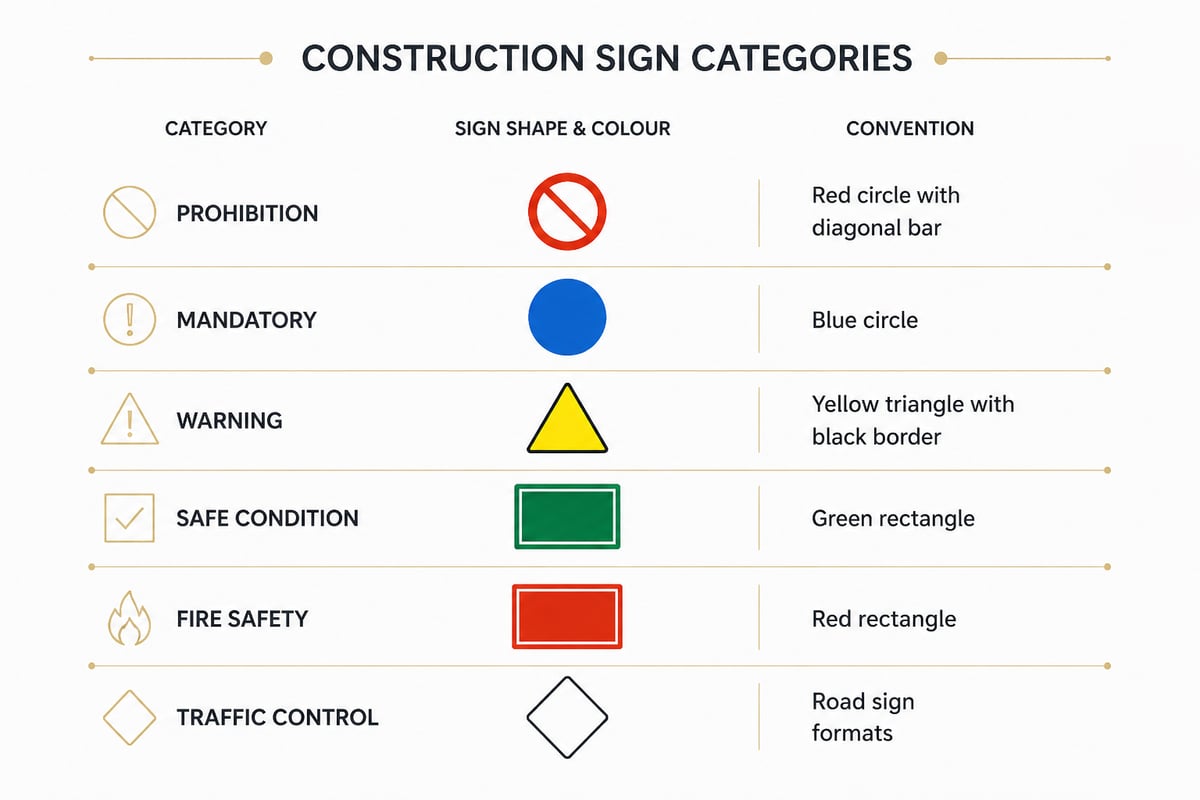
Construction sites typically display several categories of sign, including prohibition, mandatory, warning, safe condition, fire safety and traffic control. Each category has its own shape and colour, so a worker can recognise the message before reading a word.
- Prohibition signs are red circles with a diagonal bar. They cover instructions such as "No unauthorised entry", "No smoking" and "No naked flames".
- Mandatory signs are blue circles with a white symbol. Hard hats, safety boots, eye protection, hearing protection and high-visibility clothing are the most common.
- Warning signs are yellow triangles with a black border and symbol. They flag excavations, overhead loads, live electricity, slip hazards and moving vehicles.
- Safe condition signs are green rectangles. They mark first aid stations, emergency exits, assembly points and eyewash stations.
- Fire safety signs are red rectangles. They identify extinguishers, hose reels and alarm call points.
- Traffic control signs manage vehicles. Speed limits, one-way routes, stop points and pedestrian crossings belong here.
Beyond these categories, most sites also need information boards. A site notice board lists the principal contractor, emergency contacts and permit details, while a project board names the client and the development. Gate signs combine several messages: keep out, visitors report to the site office, PPE required beyond this point.
What is the basic colour for construction signs?
The basic colours for construction signs are red for prohibition and fire equipment, blue for mandatory actions, yellow for warnings, green for safe conditions and orange for temporary road work zones. Colour coding is deliberate. A person approaching a hazard at walking pace, or a driver slowing at a gate, should read the sign's category from its colour and shape within a second or two.
Orange deserves separate mention. Iowa DOT specifies a black symbol or legend on an orange background for work-zone warning signs, and gives 48 × 48 in (1200 × 1200 mm) as the standard size for diamond-shaped warning signs. That convention is a useful reference for any site with temporary traffic arrangements, even though South African roadworks follow local road traffic sign standards.
Contrast matters as much as colour choice. A faded or dirty sign loses its meaning, so replace signs that have bleached in the sun or been splashed with concrete slurry.
What are the legal requirements for construction signs?
Construction signs must follow the safety-sign standards and health and safety regulations that apply to your site, and they should only be used where a significant risk remains after other controls are in place. In South Africa, construction work falls under the Occupational Health and Safety Act and its Construction Regulations, and safety sign design is normally based on the SANS 1186 series. The OSHA question that often appears in searches refers to United States rules, so confirm your obligations with your principal contractor or health and safety officer rather than relying on foreign standards.
The principles behind good signage are consistent across jurisdictions, and the UK's Health and Safety Executive states them clearly:
- Signs are needed when significant health and safety risks remain after other relevant measures, and too many signs can cause confusion.
- Signs should be placed early enough for people to see and understand them, so they can take risk-reducing action before reaching the hazard. The same guidance requires signs to be clear, noticeable, clean and maintained.
- Where a private site uses road signs to warn or inform traffic, the signs should match public-road signs wherever a suitable sign exists.
Sign legislation is a reference point, not a substitute for a site-specific risk assessment. The assessment tells you which hazards need signs, and the signs then support the controls you have already put in place, such as barriers, exclusion zones and permit systems.
Which construction signs does a site need first?
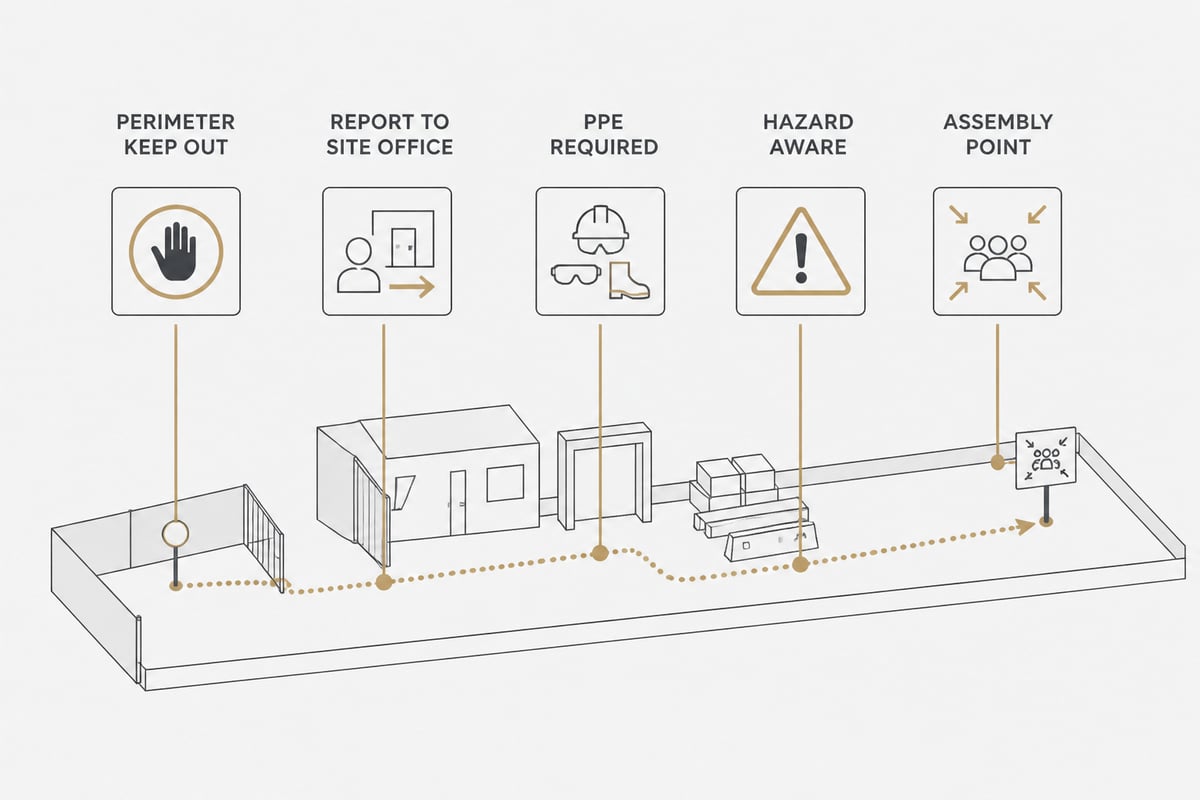
A site typically needs a perimeter keep-out sign, a PPE requirements sign, a visitor reporting sign at the gate, an emergency assembly point sign and signs for any hazard that cannot be removed. The following order works well for most projects:
- Perimeter and gate signs. "Construction site: keep out", "Authorised personnel only" and "Visitors and drivers report to the site office".
- PPE signs. Mandatory hard hat, boots and high-visibility clothing at the entrance, with additional signs at areas needing eye or hearing protection.
- Hazard warnings. Open excavations, overhead work, incomplete scaffolding, live electrical equipment and plant movement.
- Emergency signs. First aid location, fire extinguishers, emergency exits and the assembly point.
- Traffic signs. Speed limits, one-way systems, reversing vehicle warnings and pedestrian routes.
- Public protection signs. Warnings on boundary fencing facing pavements and roads.
Start with the entrance and work inwards. A visitor should meet the keep-out message, the PPE requirement and the reporting instruction in that sequence, before reaching the first working area.
Where should construction signage be placed?
Place each sign at the point where a person must make a decision, at eye level and on the approach side of the hazard, so there is time to react. Think of the sign set as a journey through the site rather than a collection of isolated notices.
Height and visibility are practical concerns:
- Mount pedestrian signs at roughly eye level and keep them clear of scaffolding, stacked materials and parked plant.
- Face signs towards the person who needs the message. A warning on the back of a hoarding helps nobody approaching from the front.
- Repeat key messages at each entrance if the site has more than one gate.
- Angle signs slightly away from direct sun and glare where possible.
For vehicle-facing signs, spacing and position follow road conventions. Iowa DOT notes that signs generally belong on the right side of the roadway, with duplicates on divided highways, and offers spacing guidance for sign series of 250 ft in urban or low-speed areas, 500 ft on arterials and rural roads, and 1,000 ft on expressways. On a typical site access road, the principle is simply to give drivers more warning distance as their speed rises.
What is the best material for construction signage?
The best material depends on how long the sign must last and how harsh the conditions are. For most construction signs, aluminium composite, rigid PVC, correx (corrugated plastic) and reflective aluminium are the standard choices.
| Material | Typical use | Strengths | Limitations |
|---|---|---|---|
| Aluminium composite panel | Long-term site boards, project signs | Rigid, weather-resistant, flat finish | Heavier and costlier than plastic |
| Rigid PVC | Gate and PPE signs, internal notices | Affordable, easy to fix, good print quality | Can warp in prolonged heat |
| Correx (corrugated plastic) | Short-term or temporary warnings | Lightweight, cheap, quick to replace | Less durable, can flex in wind |
| Reflective aluminium | Traffic signs, night-time hazards | Visible in headlights and low light | Higher cost per sign |
| Vinyl banners | Perimeter fencing, hoarding wraps | Large format, quick to install | Needs secure fixing against wind |
South African conditions add specific demands. Strong summer UV in Gauteng, coastal salt air in Durban and Cape Town, and high winds on exposed hoardings all shorten the life of poorly chosen materials. Ask your supplier to recommend a substrate and print method suited to the site's location and duration. Signshoponline advises on the best materials and production methods whether you need one sign or several hundred.
How big should a construction sign be?
A construction sign should be large enough to be read from the distance at which a person must act on it. In general, the faster the approach and the longer the message, the bigger the sign needs to be.
For pedestrian areas, signs of A3 or A2 size usually work at gates and entrances, while smaller A4 signs suit internal areas such as a first aid point. Large project and information boards are often several square metres. For vehicle approaches, size and lettering height need to increase significantly. The 1200 × 1200 mm figure used for work-zone warning diamonds in the Iowa DOT manual illustrates how large roadside warnings are when drivers have seconds to respond.
Keep wording short. Use the standard symbol, a few words and nothing more. A sign carrying a paragraph of instructions will not be read by someone walking past with a load.
How do you keep a construction signage set effective?
An effective sign set is checked regularly, updated as the site changes and kept free of clutter. Conditions on a building site change often, and signs that were correct at the start can become misleading later.
- Inspect on a schedule. Check signs for damage, fading, dirt and obstruction during routine site inspections.
- Move signs as work moves. An excavation warning must travel with the excavation, and scaffold signs must change when the scaffold is completed or dismantled.
- Remove obsolete signs. A sign for a hazard that no longer exists dilutes the signs that matter.
- Avoid overloading. If a gate carries a dozen notices, none of them will be read. Group related messages on one properly designed board.
- Brief everyone. Include the sign meanings in site inductions so that visitors, subcontractors and delivery drivers all understand the system.
Consistency helps too. Use the same style, typeface and symbol conventions across the site so the set reads as one system. This also keeps site branding tidy, which matters when clients and inspectors visit.
Custom construction signage for South African sites and businesses
Standard stock signs cover many needs, but custom construction signage is often the better route when a site has specific hazards, branded hoarding or several hundred items to produce. Custom production lets you combine safety messages with company branding, supply identical sets across multiple sites and match wording to your health and safety plan.
Signshoponline produces signage for premises, vehicles and events, and its team can advise on materials, sizes and production methods for a construction project. Site vehicles can carry branding that identifies the contractor and reinforces safety messages, and project hoarding and banners can present the development professionally to the surrounding community. For specifics such as sizes, quantities and lead times on safety signs, contact Signshoponline through its website rather than assuming standard terms.
Sites rarely work with signage alone. Temporary power arrangements affect where electrical warning signs belong, and a qualified electrical contractor can confirm the hazards that need marking. Where the project involves structural repair or inspection work, a specialist such as Souffront Construction and Engineering illustrates the kind of building work, from concrete restoration to milestone building recertification, that depends on clear site marking and access control.
FAQ
What is the material for signage?
Common signage materials include aluminium composite, rigid PVC, correx, reflective aluminium and vinyl. The right choice depends on the sign's lifespan, exposure to sun, wind and salt air, and whether it needs to be visible at night.
What are the OSHA requirements for signs?
OSHA is the United States workplace safety regulator, so its rules apply to American sites rather than South African ones. For a site in South Africa, follow the Occupational Health and Safety Act, the Construction Regulations and the relevant SANS sign standards, and confirm details with your health and safety officer.
How many signs does a construction site need?
There is no fixed number. Signs are needed where a significant risk remains after other controls, and too many can cause confusion, so base the set on your risk assessment and place each sign where a decision or action is needed.
Walk your site entrance to the first working area this week and note every point where a visitor or driver needs a warning, instruction or direction that is missing or faded. With that list in hand, you can brief a supplier accurately on sizes, materials and quantities. Signshoponline can help you get a quote for a construction signage set that matches your site and your budget.


