


Prohibited signage tells people what they must not do in a given place, and it does so through a recognisable shape and colour code: a round sign with a red ring, a diagonal red bar and a black pictogram on a white background. A well-chosen prohibition sign removes ambiguity, reduces risk and protects your premises, staff and customers without a word of explanation.
This guide covers what these signs look like, the main categories, how road and workplace versions differ, and how to choose materials and positions that suit South African conditions, from a restaurant in Cape Town to a warehouse in Gauteng.
What Is the Prohibition Sign and How Is It Designed?
The prohibition sign is a round safety sign with a black pictogram on a white background, red edging and a diagonal red line running from top left to bottom right. The Health and Safety Executive states that the red portion must cover at least a set proportion of the sign's area, which is why the ring and bar look so heavy.
That proportion matters. The red band is what the eye registers first, often before the pictogram itself is readable. A sign that shrinks the red area to fit a decorative layout loses its immediate warning quality.
Each part of the design carries a job:
- Circular shape: signals an instruction or restriction rather than information.
- Red ring and diagonal bar: signals that the depicted action is forbidden.
- Black pictogram: shows the forbidden action or object in a form that works across languages.
- White background: maintains contrast so the symbol stays legible at distance.
Because South Africa is a multilingual country, pictogram-led design is a practical advantage. A visitor, delivery driver or temporary worker can understand the instruction without reading any text.
The Main Types of Prohibited Signage
Prohibited signage falls into a handful of recurring categories, defined by the action or hazard they restrict. The HSE lists examples such as smoking, naked flames, pedestrian access, extinguishing with water, unauthorised access and industrial vehicles.
The most common types you will meet on commercial premises are:
- No smoking: required in enclosed public spaces and widely used in restaurants, offices and fuel areas.
- No naked flames: used near gas, solvents, fuel stores and spray-painting areas.
- No entry or unauthorised access: marks plant rooms, stockrooms, roofs and staff-only zones.
- No pedestrians: used where vehicles or machinery operate, such as loading bays and yards.
- No mobile phones: used near fuel pumps, some medical areas and quiet or secure rooms.
- Do not use water to extinguish: placed near electrical equipment and certain chemical stores.
- No parking or no stopping: controls vehicle access, fire lanes and delivery points.
- No photography: protects private, secure or intellectual-property-sensitive areas.
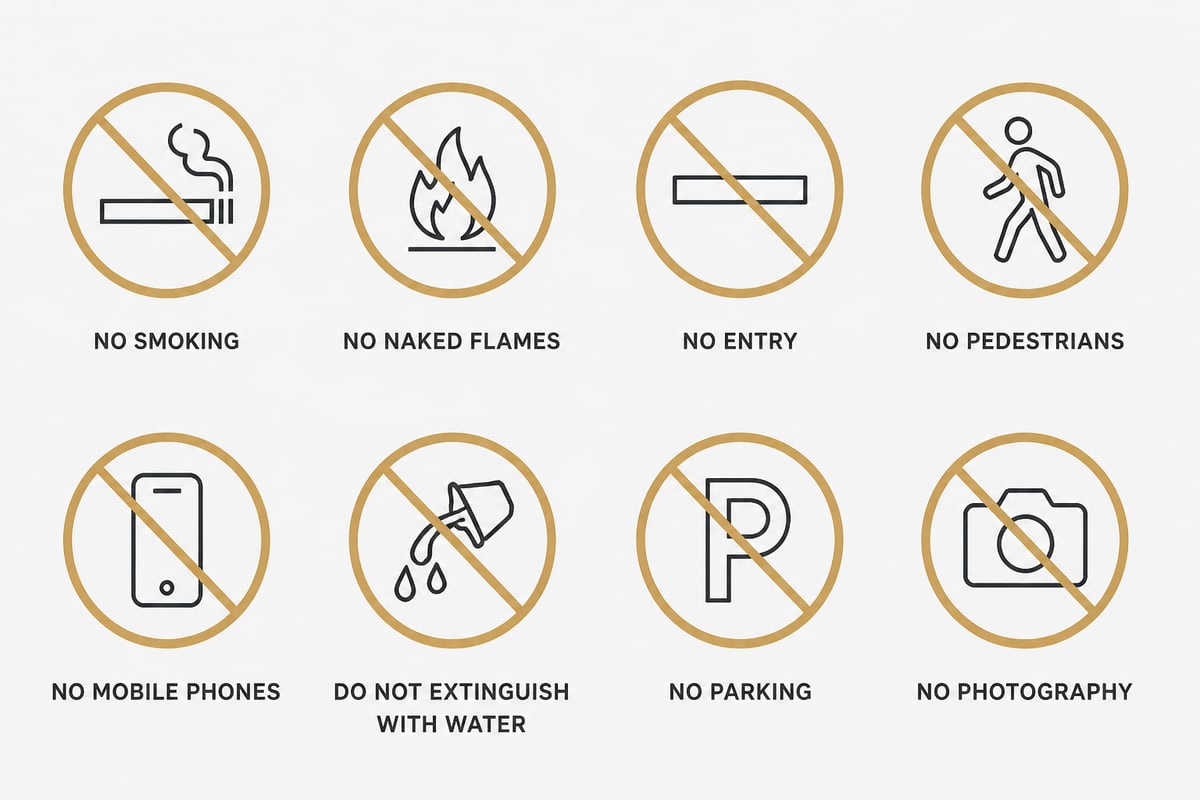
A single site often needs several of these at once. A restaurant kitchen, for example, may need no-entry signs on the cold room door, no-naked-flame notices near gas storage and no-smoking signs at the entrance and delivery area.
What Is a Prohibited Traffic Sign?
A prohibited traffic sign is a regulatory road sign that forbids a specific action, such as entering a road, turning, overtaking or stopping. In Great Britain, GOV.UK explains that most regulatory traffic signs are circular and that a red ring or red circle indicates a prohibition.
The same visual logic that governs workplace signs therefore appears on the road. The Highway Code reinforces this, noting that signs with red circles are mostly prohibitive and that plates below the sign qualify its message.
Typical examples include:
- No entry for vehicular traffic
- No right or left turn
- No overtaking
- Maximum speed limits
- No stopping or waiting
South African road signs follow a comparable red-circle convention, though the formal rules for public roads are set by the relevant national and provincial authorities. For private property such as shopping centres, estates, business parks and company yards, owners usually choose their own traffic signage, and aligning it with the familiar red-circle style makes it instantly understood by drivers.
Parking and stopping controls have their own detailed conventions. The UK's guidance on on-street parking control signs and road markings is a useful reference for how waiting prohibitions and clearways are communicated, even where you are adapting the principles for a private site.
Supplementary Plates: Adding Exceptions and Detail
A supplementary plate is a small panel fixed below a prohibition sign to state when, where or for whom the restriction applies. GOV.UK notes that plates can specify exceptions, including access to adjacent premises or land and goods-vehicle loading or unloading.
This solves a common problem. A bare "No Stopping" sign is rigid, whereas a sign with a plate reading "Except for loading, 07:00 to 10:00" communicates a workable rule that suppliers and customers can follow.
Useful plate wording on commercial premises includes:
- "Authorised vehicles only"
- "Deliveries only, 06:00 to 09:00"
- "Customers only while shopping"
- "Staff access only"
- "Except for loading"
Keep plate text short, high-contrast and legible from the same distance as the main sign. If the plate cannot be read from where the driver or visitor decides to act, it fails its purpose.
Prohibition Signs Versus the Other Safety Sign Categories
Prohibition signs are one of several colour-coded categories, and mixing them up weakens the whole system. The core families used in workplaces are consistent, though the exact grouping depends on the standard applied.
| Category | Shape and colour | Meaning | Example |
|---|---|---|---|
| Prohibition | Round, red ring and bar on white | Must not do | No smoking |
| Mandatory | Round, white symbol on blue | Must do | Wear eye protection |
| Warning | Triangular, black on yellow | Hazard present | Slippery floor |
| Safe condition | Rectangular or square, white on green | Safe route or aid | Emergency exit |
| Fire equipment | Rectangular or square, white on red | Fire-fighting point | Extinguisher location |
For fire safety specifically, signs fall mostly into the fire equipment and safe condition families. In the UK, fire safety signs follow British Standard conventions, with green signage for escape routes and red for fire-fighting equipment. Prohibition signs such as "Do not use lifts in a fire" or "No smoking" work alongside them but remain a separate category.
Using the wrong shape or colour for a message creates confusion at exactly the moment clarity matters. If something is forbidden, it needs the red ring and bar, not a yellow triangle.
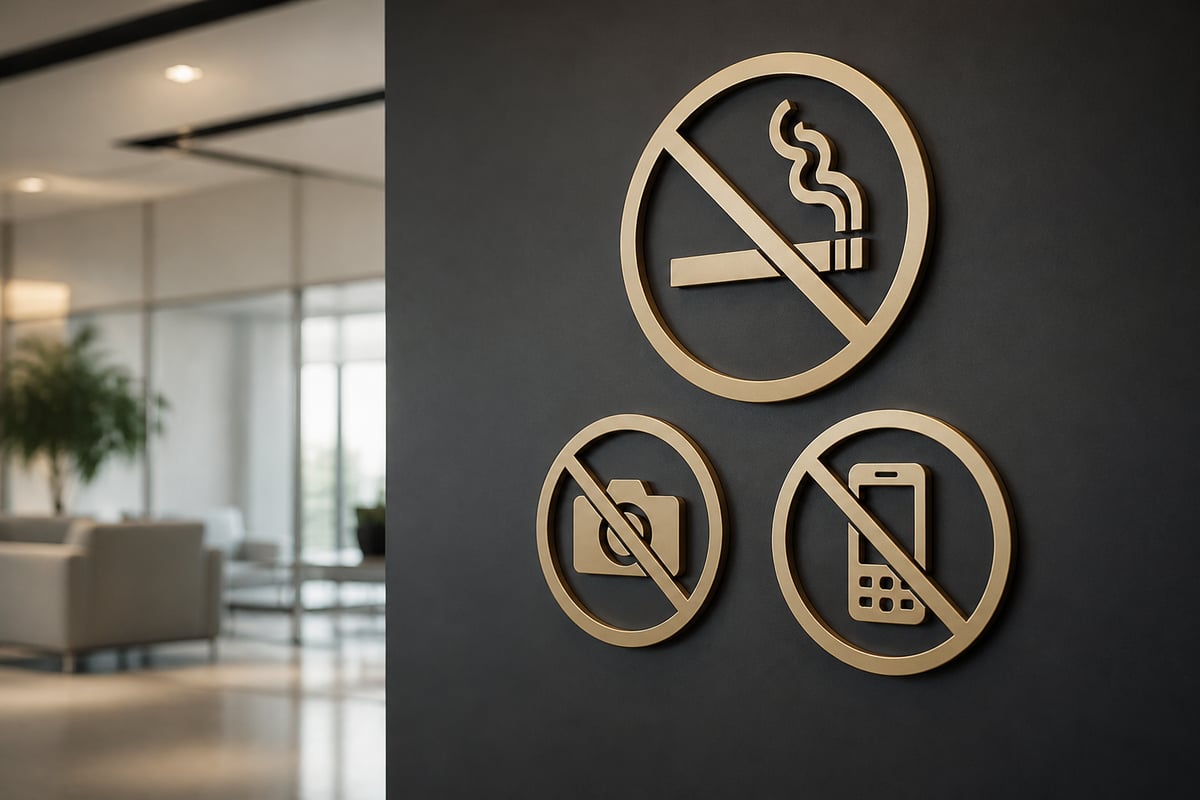
Choosing Materials and Formats for South African Conditions
The right material for prohibited signage depends on where it will hang and how long it needs to last. Local conditions such as strong UV exposure, coastal salt air and dusty industrial areas all shorten the life of poorly chosen signs.
Consider these options:
- Aluminium composite and rigid plastic: durable, flat and suitable for most indoor and outdoor prohibition signs.
- Reflective sheeting: improves visibility for vehicle prohibitions in car parks, yards and access roads at night.
- Vinyl decals: quick and economical for glass doors, windows and smooth interior walls.
- Illuminated or neon formats: suited to bars, restaurants and entertainment venues where a prohibition such as "No Smoking" or "Staff Only" should also fit the décor.
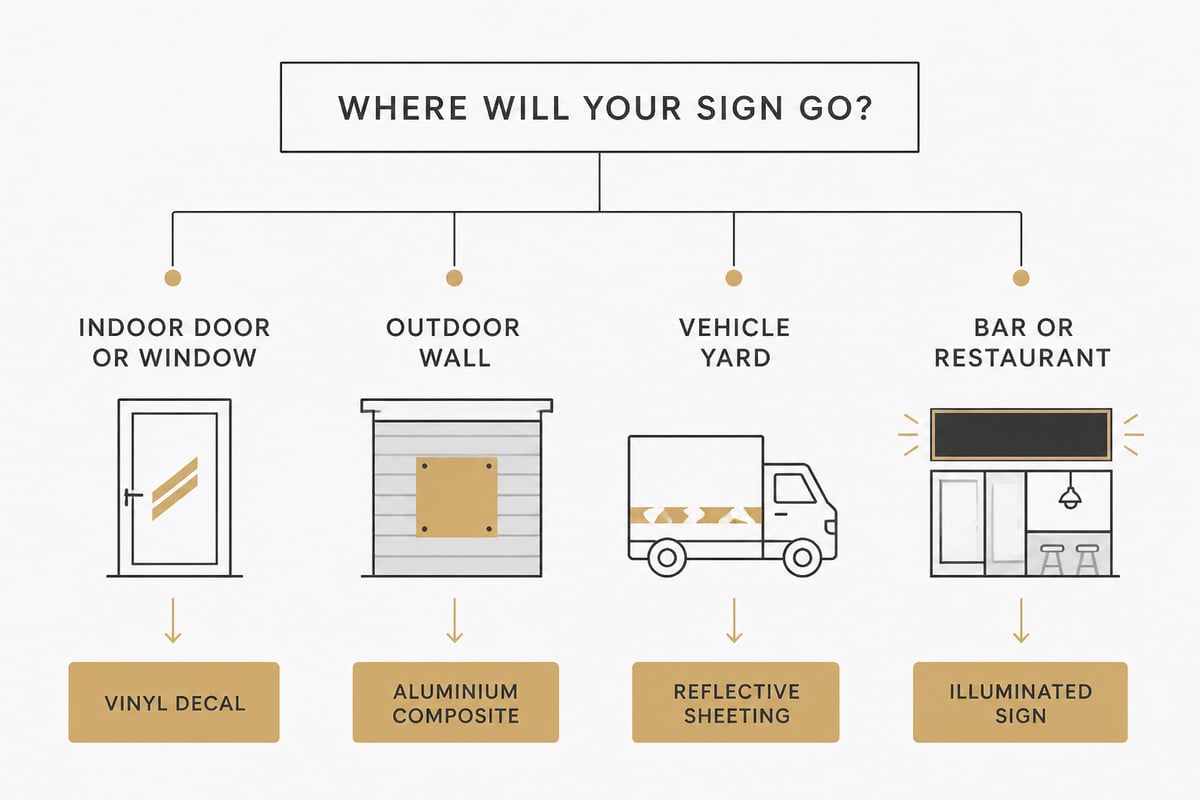
Hospitality venues often want signage that reinforces their brand rather than clashing with it. A custom illuminated sign can carry a prohibition message in a style that suits the interior while keeping the red ring and bar recognisable. Signshoponline is a full-service signage company that manufactures, installs and designs signs, and advises on the best materials and production methods whether you need one sign or several hundred. For specifications and options, the product pages and contact page are the right place to check what suits your site.
Where and How to Place Prohibited Signage
A prohibition sign works only if people see it before they commit to the action it forbids. Placement therefore matters as much as design.
Follow these principles:
- Place the sign at the decision point. A no-entry sign belongs on the door or at the gate, not ten metres back.
- Mount at a readable height. Eye level for pedestrians, higher and larger for drivers who view signs from a moving vehicle.
- Keep sightlines clear. Do not let shelving, plants, vehicles or other signs hide the message.
- Ensure lighting. Poorly lit signs fail at night, so use reflective or illuminated formats where needed.
- Avoid clutter. Too many signs in one spot dilute each message; group them logically and remove outdated ones.
- Size for distance. The further the viewer, the larger the sign and pictogram must be.
Vehicle-related prohibitions deserve particular care. Motorways in the UK, for example, carry strict rules on stopping, U-turns and reversing, and the guidance on motorway signs, signals and road markings shows how such restrictions are communicated. The principle transfers to private access roads and ramps: state the restriction clearly, early and consistently.
Prohibited Signage for Vehicles and Events
Prohibitions do not apply only to fixed premises. Companies with fleets and organisers of temporary events also need to communicate what is not permitted.
For vehicles, branded fleets often carry notices such as "No smoking in vehicle", "No unauthorised passengers" or "Do not follow too closely". Vehicle branding allows these messages to sit alongside your company identity in a consistent format.
For events, crowd control relies on clear restrictions. Typical examples include:
- No entry beyond this point
- No bags or large items
- No outside food or drink
- No re-entry
- No photography in restricted areas
Banners and teardrop flags can carry temporary prohibition messages at gates, marquee entrances and parking areas, and are easy to relocate as the event layout changes. Because event signage is often read quickly and from a distance, keep the wording to a few words and rely on the symbol.
Common Mistakes with Prohibited Signage
Most failures come from small design or placement errors rather than the message itself. Avoiding the following problems keeps your signs effective:
- Altering the colour scheme. Replacing red with a brand colour weakens recognition.
- Using text only. A sentence on a plain board is slower to read than a pictogram.
- Placing signs too high or too low. Misjudged height means the sign goes unseen.
- Leaving faded or damaged signs in place. Sun-bleached red looks inactive and invites disregard.
- Contradicting messages. A "No Parking" sign beside a bay marked for parking creates doubt.
- Ignoring local requirements. Signs required by law, building regulations or insurers should meet the relevant standards for your sector.
Inspect your signs regularly. Replace anything faded, cracked or obscured, and review the layout whenever you change how a space is used.
FAQ
What are the 7 safety symbols?
The most commonly cited families are prohibition, mandatory, warning, safe condition and fire equipment signs, with some standards also separating information and hazard-specific symbols. Each uses a defined shape and colour so the message is understood at a glance.
What are the British standard fire safety signs?
British standard fire safety signs use green rectangular signs with white symbols for escape routes and exits, and red rectangular signs for fire-fighting equipment such as extinguishers and alarm points. Prohibition signs, such as no smoking or no naked flames, complement them using the red ring and diagonal bar.
Do prohibition signs need text as well as a symbol?
A pictogram alone is usually understood, but adding short text helps where the restriction has conditions, such as times or authorised groups. A supplementary plate is the cleanest way to add that detail without cluttering the symbol.
Start by walking your premises and listing every place where a restriction currently relies on a verbal instruction or a faded sign, then note which category and format each one needs. Once you have that list, Signshoponline can help you choose suitable materials and formats, from durable outdoor signs and vehicle branding to illuminated neon pieces for venues, so you can get a quote that covers everything in one go. The team can advise on one sign or several hundred.


