


LED digital signage has revolutionised how businesses communicate with customers, employees, and visitors across virtually every sector. These dynamic displays combine the energy efficiency and longevity of light-emitting diode technology with sophisticated content management systems to deliver messages that capture attention and drive engagement. From retail environments and corporate lobbies to transport hubs and outdoor advertising spaces, led digital signage offers unparalleled flexibility and impact compared to traditional static signage. As we progress through 2026, advances in display technology, reduced costs, and improved content creation tools continue to expand the possibilities for organisations seeking to modernise their visual communication strategies.
Understanding LED Digital Signage Technology
LED digital signage encompasses a broad category of electronic display systems that use light-emitting diodes as the primary light source or display element. Unlike traditional fluorescent-backlit screens, modern LED technology delivers superior brightness, contrast, and colour reproduction whilst consuming significantly less energy.
Core Display Technologies
The term "LED digital signage" actually refers to several distinct technologies, each suited to different applications and environments. Direct-view LED displays use arrays of individual LED modules to create the image itself, with each pixel composed of red, green, and blue diodes. These displays excel in outdoor environments and large-format installations where viewing distances exceed several metres.
LCD panels with LED backlighting represent another common category, offering higher pixel density for closer viewing distances. These screens use liquid crystal technology illuminated by LED light sources, achieving excellent image quality at competitive price points. Mini-LED backlighting has emerged as a significant advancement, using thousands of tiny LEDs to provide precise local dimming and enhanced contrast ratios that rival OLED technology in many applications.
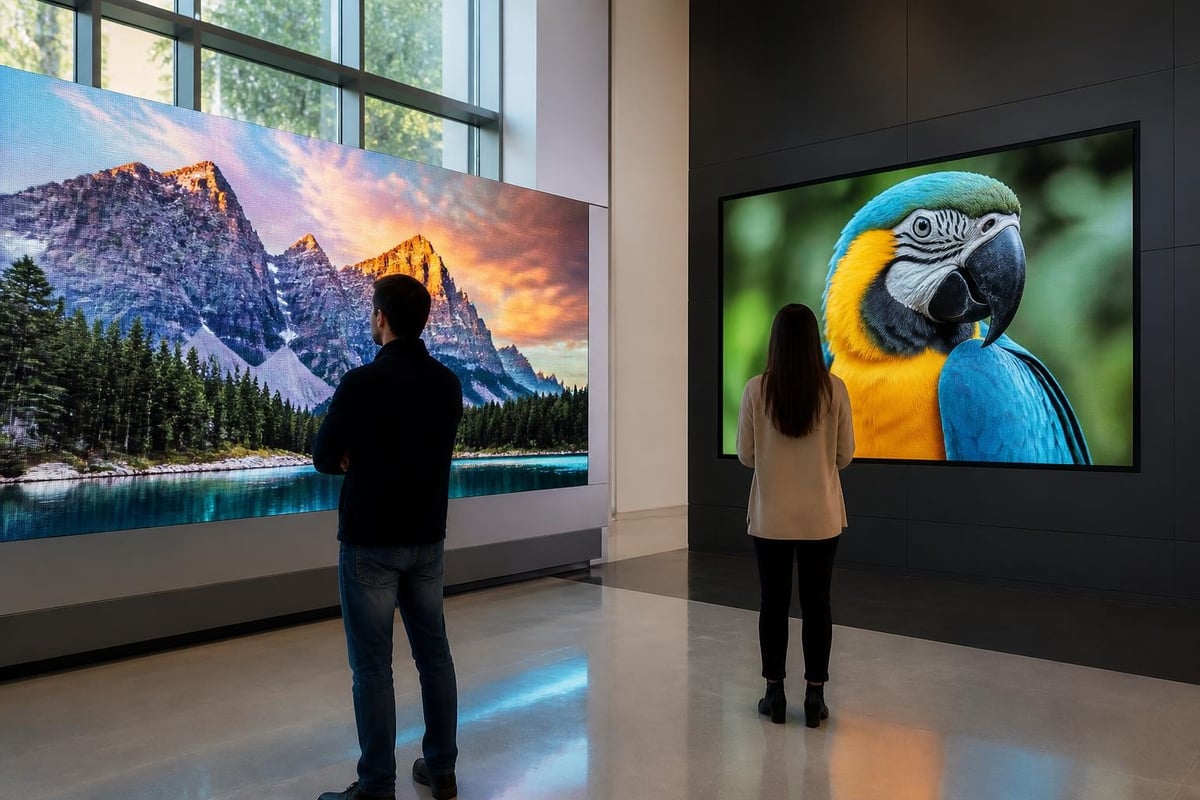
According to research from the Institute of Electrical and Electronics Engineers, mini-LED and emerging microLED displays promise to reshape the digital signage landscape by delivering cinema-quality images with unprecedented energy efficiency.
| Display Type | Typical Pixel Pitch | Best Applications | Brightness Range |
|---|---|---|---|
| Direct-view LED | 2mm - 20mm | Outdoor, large venues | 5,000 - 10,000 nits |
| LCD LED-backlit | 0.2mm - 0.5mm | Indoor, close viewing | 300 - 700 nits |
| Mini-LED LCD | 0.2mm - 0.5mm | Premium indoor | 1,000 - 2,000 nits |
| MicroLED | 0.5mm - 2mm | High-end applications | 2,000 - 5,000 nits |
Energy Efficiency and Performance
The International Energy Agency highlights that the next generation of LED lighting and display technology prioritises efficiency, circular design, and intelligent control systems. For digital signage operators, this translates to dramatically lower operating costs compared to legacy technologies.
Modern led digital signage consumes 40-60% less energy than equivalent plasma or CCFL-backlit LCD displays whilst delivering superior brightness. Automated brightness sensors adjust output based on ambient lighting conditions, further reducing power consumption without compromising visibility. Many commercial displays now incorporate scheduling features that power down screens during off-hours or dim content when foot traffic decreases.
Thermal management remains critical for LED longevity. Quality commercial displays incorporate active cooling systems, heat sinks, and thermal monitoring to maintain optimal operating temperatures. Proper thermal design directly impacts lifespan, with well-engineered LED digital signage systems routinely achieving 50,000 to 100,000 hours of operation before reaching half their original brightness.
Strategic Applications Across Industries
Led digital signage serves diverse functions across virtually every business sector, adapting to specific communication needs and environmental constraints.
Retail and Hospitality Environments
Retail spaces leverage led digital signage to create immersive brand experiences, promote merchandise, and guide customers through stores. Window displays using high-brightness LED panels capture attention from passing pedestrians even in direct sunlight. Interior screens positioned at decision points influence purchasing behaviour by showcasing products, pricing, and promotional offers in real-time.
- Queue management systems reduce perceived wait times by entertaining customers with dynamic content
- Menu boards in restaurants and cafés enable instant price updates and highlight limited-time offerings
- Wayfinding displays help visitors navigate complex retail environments and locate departments
- Interactive kiosks combine LED screens with touch interfaces for product browsing and self-service
Hospitality venues employ led digital signage for guest information, event promotion, and brand storytelling. Hotel lobbies feature large-format displays showcasing amenities and local attractions, whilst conference centres use digital signage networks to direct attendees and display schedules. Businesses seeking traditional illuminated signage options can explore lightbox solutions that complement digital displays in cohesive signage programmes.
Corporate Communication and Workplace Integration
Modern workplaces deploy led digital signage to enhance internal communications, celebrate achievements, and reinforce corporate culture. Reception areas create powerful first impressions with branded content on professional displays, whilst common areas feature screens sharing company news, performance metrics, and employee recognition.
Meeting room booking displays positioned outside conference rooms eliminate scheduling conflicts by showing real-time availability and reservation details. Emergency notification systems integrate with building management to broadcast evacuation instructions and safety information across distributed screen networks.
Technical Specifications and Selection Criteria
Choosing appropriate led digital signage requires careful evaluation of technical parameters matched to specific deployment scenarios. For a full breakdown of LED screen specifications and how they match each deployment, see our LED screen guide for business applications.
Brightness and Viewing Environment
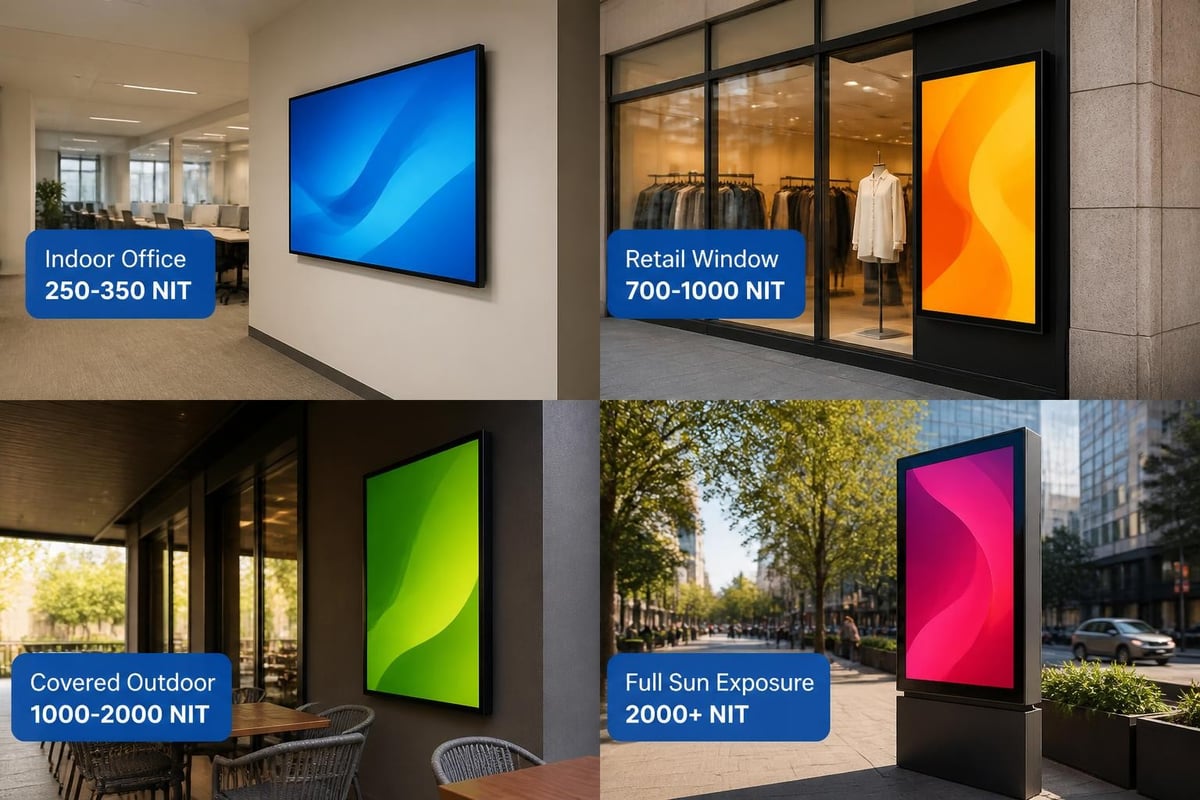
Nit ratings measure display brightness, with different environments demanding vastly different output levels. Indoor applications typically require 300-700 nits for comfortable viewing under normal lighting. Environments with significant natural light, such as atriums or windowed corridors, benefit from 700-1,500 nit displays.
Outdoor led digital signage demands 2,500-10,000 nits to remain visible in direct sunlight. The U.S. Department of Energy's solid-state lighting research provides valuable insights into LED performance characteristics and efficiency benchmarks relevant to high-brightness applications.
Pixel Pitch and Viewing Distance
Pixel pitch measures the distance between LED clusters, directly affecting image resolution and optimal viewing distance. The relationship follows a simple principle: smaller pixel pitch enables closer viewing with sharper images but increases cost significantly.
Recommended minimum viewing distances:
- 1.2mm pitch: 1.2 metres minimum viewing distance
- 2.5mm pitch: 2.5 metres minimum viewing distance
- 6mm pitch: 6 metres minimum viewing distance
- 10mm pitch: 10 metres minimum viewing distance
- 16mm pitch: 16 metres minimum viewing distance
Indoor applications benefit from tighter pixel pitches (1.2mm-4mm) to accommodate closer viewing, whilst outdoor billboards and stadium screens can employ wider pitches (10mm-20mm) given the greater viewing distances involved. For businesses exploring various signage technologies, moving LED signs offer a specialised category of programmable displays suited to attention-grabbing applications.
Environmental Protection and Compliance
Outdoor led digital signage must withstand temperature extremes, precipitation, dust, and physical impact. The NEMA 250 standard defines enclosure types and environmental protection ratings essential for specifying appropriate housings.
| NEMA Rating | Protection Level | Suitable Environments |
|---|---|---|
| NEMA 1 | Indoor, general purpose | Climate-controlled spaces |
| NEMA 3R | Outdoor, rain/sleet | Covered outdoor areas |
| NEMA 4 | Outdoor, dust/water | Fully exposed installations |
| NEMA 4X | Outdoor, corrosive | Marine, industrial environments |
Safety certifications verify that led digital signage meets electrical and fire safety standards. UL 48 certification specifically addresses electric signs, covering construction, wiring, and component requirements. Compliance with relevant standards protects occupants, satisfies building codes, and limits liability exposure for property owners.
Content Strategy and Management Systems
Hardware excellence means little without compelling content delivered through reliable management platforms. Effective led digital signage combines technical capability with strategic messaging.
Content Management Platforms
Modern content management systems (CMS) enable centralised control of distributed screen networks from web-based interfaces. Cloud platforms eliminate the need for on-site servers whilst providing real-time updates, scheduling flexibility, and remote troubleshooting capabilities.
Key CMS features include:
- Multi-screen synchronisation for coordinated messaging across locations
- Template libraries enabling consistent branding and rapid content creation
- Playlist scheduling with dayparting for time-specific messaging
- Emergency override capabilities for urgent communications
- Analytics tracking content performance and audience engagement
- Third-party integrations pulling live data from social media, weather services, and business systems
Professional content creation remains essential despite simplified tools. High-resolution graphics optimised for specific screen dimensions and aspect ratios prevent distortion and pixelation. Motion graphics and video content should adhere to appropriate frame rates and codecs to ensure smooth playback across different display types.
Accessibility and Inclusive Design
Digital signage deployments must consider accessibility requirements to ensure information reaches all audiences. The U.S. Access Board provides guidance on electronic signage accessibility, addressing readability, contrast, and content presentation for people with disabilities.
Best practices for accessible led digital signage include:
- Sufficient text size relative to viewing distance (minimum 1 inch per 10 feet)
- High contrast ratios between text and backgrounds (minimum 70%)
- Readable font selections avoiding decorative or script typefaces
- Adequate dwell time allowing viewers to read complete messages
- Alternative audio descriptions for critical wayfinding or safety information
- Consideration of colour blindness in graphic design choices
Installation and Maintenance Considerations
Successful led digital signage deployments require professional installation and ongoing maintenance to protect investments and ensure reliable operation.
Site Preparation and Mounting
Structural assessment precedes installation to verify that mounting surfaces can support display weight plus safety factors. Large-format LED panels can weigh several hundred kilograms, requiring reinforced mounting points or purpose-built support structures. Wind loading calculations become critical for outdoor installations, particularly in exposed locations or regions prone to severe weather.
Electrical infrastructure must provide adequate power capacity and appropriate circuit protection. Commercial displays typically require dedicated circuits rated for continuous operation. Data connectivity options include wired Ethernet connections for maximum reliability or wireless solutions where cabling proves impractical. Many operators deploy both, using wired connections as primary pathways and wireless as backup.
Professional installation addresses:
- Structural engineering validation and mounting system specification
- Electrical service sizing and circuit installation
- Network infrastructure provisioning and bandwidth allocation
- Environmental controls including ventilation and climate management
- Security measures protecting against theft and vandalism
Preventative Maintenance and Lifecycle Management
Establishing maintenance protocols extends led digital signage lifespan and prevents costly downtime. Regular inspections identify developing issues before they cause failures, whilst cleaning schedules maintain optimal image quality and prevent dust accumulation that compromises cooling.
Maintenance schedule components:
| Task | Frequency | Purpose |
|---|---|---|
| Visual inspection | Weekly | Identify physical damage or display anomalies |
| Screen cleaning | Monthly | Remove dust, fingerprints, maintain clarity |
| Ventilation check | Quarterly | Ensure proper airflow, prevent overheating |
| Software updates | Quarterly | Patch security vulnerabilities, add features |
| Calibration | Annually | Restore colour accuracy and brightness uniformity |
The Department of Energy's guidance on purchasing energy-efficient LED luminaires offers procurement criteria applicable to led digital signage, emphasising lifecycle costs beyond initial purchase price. Total cost of ownership calculations should factor in energy consumption, maintenance requirements, and expected replacement intervals.
Emerging Technologies and Future Developments
The led digital signage sector continues evolving rapidly, with emerging technologies promising enhanced capabilities and new application possibilities.
MicroLED and Next-Generation Displays
MicroLED technology represents the convergence of direct-view LED and flat-panel display manufacturing, using microscopic LEDs to achieve pixel pitches below 1mm. These displays deliver exceptional brightness, colour accuracy, and energy efficiency without the burn-in concerns affecting OLED panels. Industry coverage from Display Week conferences showcases research advancing microLED manufacturing techniques and driving down production costs.
Transparent LED displays create striking installations where viewers see through the screen to objects or spaces behind, enabling innovative retail windows, architectural features, and museum exhibits. These specialised panels sacrifice some brightness and pixel density but offer unique design possibilities impossible with conventional displays.
Artificial Intelligence and Automation
AI integration transforms led digital signage from simple broadcast systems into responsive, intelligent communication platforms. Computer vision systems analyse audience demographics and engagement, automatically adjusting content to match viewer profiles. Sentiment analysis interprets facial expressions to gauge message effectiveness and optimise creative approaches.
Predictive maintenance algorithms monitor display performance metrics, identifying patterns that precede component failures. This enables proactive service scheduling during convenient windows rather than reactive emergency repairs during business hours. Machine learning optimises brightness settings based on historical data, weather forecasts, and energy tariff structures to minimise operating costs whilst maintaining visibility.
Sustainability and Circular Economy
Environmental considerations increasingly influence led digital signage procurement and deployment decisions. Manufacturers adopt circular economy principles, designing products for disassembly, component reuse, and material recovery at end-of-life. Modular construction enables selective replacement of failed components rather than discarding entire display assemblies.
Energy efficiency remains paramount, with latest-generation LED technology achieving lumens-per-watt ratings that would have seemed impossible a decade ago. Solar-powered digital signage systems eliminate grid connections for remote installations, combining high-efficiency displays with battery storage and photovoltaic arrays. Carbon accounting tools help organisations quantify the environmental impact of digital signage networks and identify reduction opportunities.
Led digital signage delivers measurable communication advantages across diverse applications when deployed strategically with appropriate technology and content. Whether upgrading existing signage or implementing new visual communication systems, Signshoponline provides comprehensive expertise spanning traditional and digital solutions, from custom fabricated signs to cutting-edge display technologies. Contact our team to discuss how the right combination of signage products can elevate your brand presence and communication effectiveness in 2026 and beyond.


