


Every workplace, regardless of industry or size, shares a fundamental responsibility: protecting the health and wellbeing of everyone who enters the premises. A properly designed and strategically placed safety sign serves as a silent guardian, communicating vital information that can prevent accidents, save lives, and ensure regulatory compliance. In 2026, as workplaces become increasingly complex and regulations more stringent, understanding the nuances of safety signage has never been more critical for business owners, facility managers, and health and safety officers.
Understanding Safety Sign Categories and Their Applications
The world of safety signage extends far beyond simple warning notices. Modern safety signs fall into distinct categories, each serving a specific purpose within the broader safety communication framework.
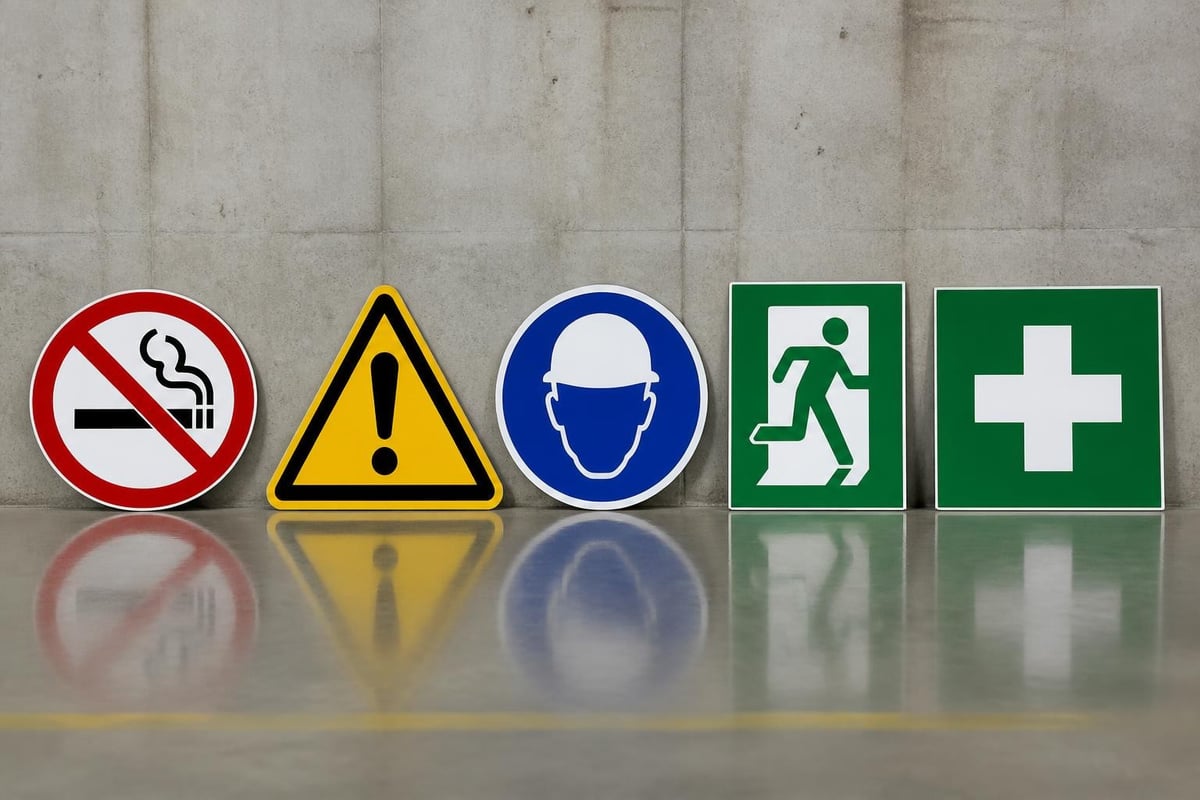
Prohibition signs communicate actions that must not be taken. These typically feature a red circular border with a diagonal line, indicating forbidden activities such as no smoking, no entry, or no mobile phones. Their bold design ensures immediate recognition.
Warning signs alert people to potential hazards in their vicinity. Characterized by triangular shapes with yellow backgrounds and black borders, these signs indicate dangers such as electrical hazards, slippery surfaces, or overhead loads. The UK Health and Safety Executive provides comprehensive guidance on proper workplace safety sign selection and deployment.
Mandatory and Emergency Information Signs
Mandatory signs require specific behaviour or actions. Displaying white symbols on blue circular backgrounds, these signs enforce requirements such as wearing personal protective equipment, washing hands, or keeping doors closed.
Emergency information signs guide people to safety during critical situations:
- First aid locations marked with green backgrounds and white symbols
- Fire exits and escape routes clearly illuminated
- Assembly points designated for evacuation procedures
- Fire-fighting equipment positions highlighted for quick access
Safe condition signs indicate the location of safety equipment or emergency routes. Their distinctive green colour psychology promotes calmness whilst ensuring visibility. These signs prove essential during emergencies when clear wayfinding can mean the difference between safety and catastrophe.
Regulatory Compliance and Legal Requirements
Navigating the regulatory landscape surrounding safety signage requires careful attention to both international standards and local requirements. In the United Kingdom, The Health and Safety (Safety Signs and Signals) Regulations 1996 establishes the legal framework governing workplace safety signs, outlining specific requirements for design, placement, and maintenance.
These regulations mandate that employers must provide safety signs where risks cannot be avoided or reduced adequately through other means. The key principle centres on ensuring that safety information reaches workers effectively, particularly in areas where hazards persist despite implementing other control measures.
| Regulation Aspect | Requirement | Compliance Action |
|---|---|---|
| Risk Assessment | Identify signage needs | Conduct thorough workplace audit |
| Sign Selection | Use prescribed formats | Follow ISO 7010 standards |
| Placement | Ensure visibility | Position at eye level, well-lit |
| Maintenance | Keep signs legible | Schedule regular inspections |
| Training | Inform workers | Provide induction and refreshers |
International Standards and Harmonization
The ISO 7010 standard has become the global benchmark for safety sign design, replacing older national variations with universally recognized pictograms. This standardization proves particularly valuable for international businesses and workplaces with diverse, multilingual workforces.
Companies operating across multiple jurisdictions must reconcile different regulatory frameworks. Whilst European standards emphasize pictorial communication, American requirements often incorporate text-based warnings. Understanding these nuances ensures comprehensive compliance.
Design Principles for Maximum Effectiveness
Creating an effective safety sign involves far more than printing a symbol on a coloured background. The science of sign design incorporates psychology, ergonomics, and visual communication principles to maximize comprehension and response rates.
Visibility stands paramount in safety sign effectiveness. Signs must be:
- Positioned within the natural sight lines of workers
- Adequately illuminated under all operating conditions
- Sized appropriately for viewing distance
- Contrasted sufficiently against background surfaces
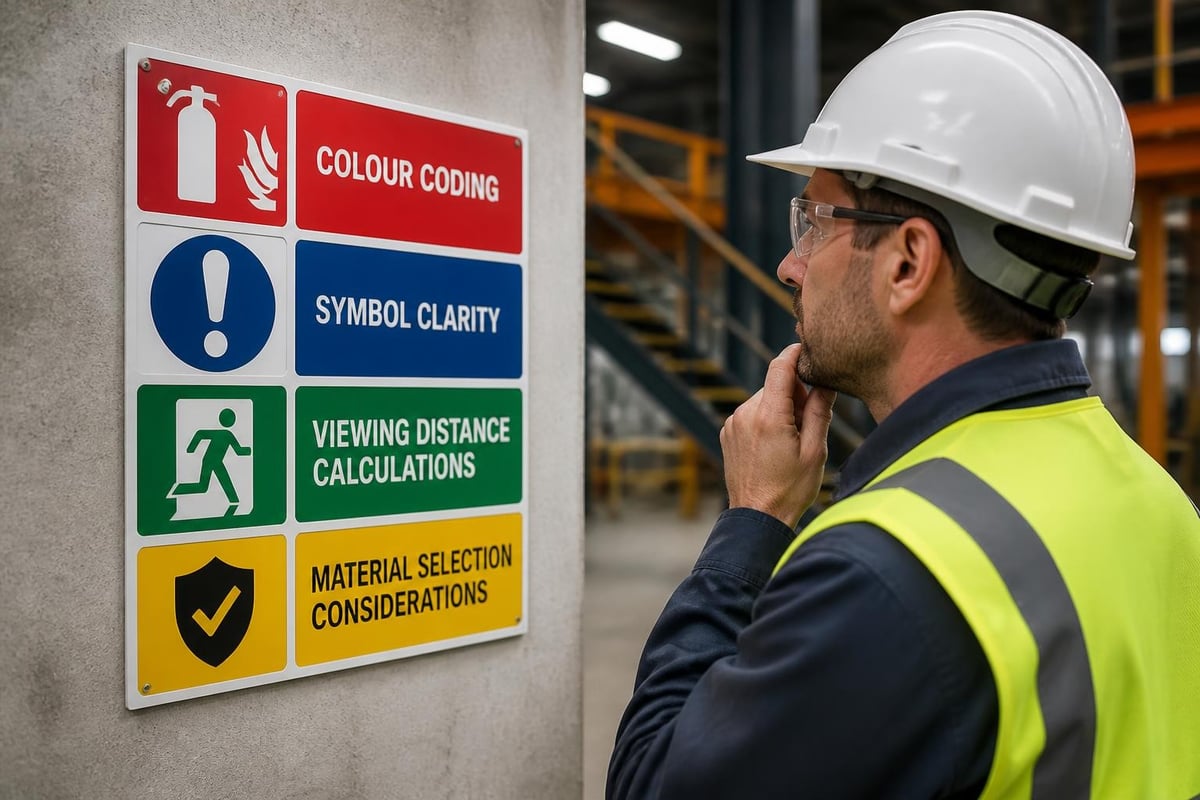
Colour selection follows strict conventions established through decades of research and standardization. Red exclusively signals prohibition or fire-fighting equipment. Yellow indicates caution and potential hazards. Blue denotes mandatory actions. Green shows safe conditions and emergency routes. These colour associations transcend language barriers, enabling instant recognition.
Typography and Symbol Design
Legibility determines whether a safety sign fulfils its protective function. Font selection, character height, and spacing all contribute to readability from distance. Sans-serif typefaces generally perform better than decorative fonts, particularly under challenging lighting conditions.
Pictogram design has evolved significantly with international standardization. Modern safety symbols employ simplified, bold graphics that communicate meaning instantly. The elimination of unnecessary detail ensures rapid comprehension, even during stressful emergency situations.
Reflective and photoluminescent materials enhance visibility during power failures or low-light conditions. These technologies prove essential for emergency exit signs and evacuation route markers, maintaining visibility when traditional lighting fails.
Strategic Placement and Installation Best Practices
Even the most brilliantly designed safety sign fails if positioned incorrectly. Strategic placement requires understanding traffic patterns, sight lines, and the specific hazards being communicated.
Location Assessment Methodology
Begin with comprehensive workplace mapping. Document all potential hazards, emergency equipment locations, and escape routes. This audit forms the foundation for determining where safety signs prove necessary.
Height considerations significantly impact sign effectiveness:
- Mount signs at consistent eye level (approximately 1.5 to 2 metres)
- Position exit signs above doorways where they remain visible above crowds
- Place floor-level hazard warnings closer to the danger point
- Ensure overhead hazard signs appear in the worker's natural sight line
The U.S. Access Board provides detailed technical guidance on mounting heights and positioning for accessible signage, ensuring compliance with disability access requirements.
Lighting conditions vary throughout facilities and across operating hours. Safety signs must remain visible during normal operations, emergency lighting conditions, and potential power failures. This requirement often necessitates illuminated or photoluminescent solutions.
Maintenance and Inspection Protocols
Safety signs deteriorate over time through environmental exposure, physical contact, and material degradation. Establishing regular inspection schedules ensures continued effectiveness.
Quarterly inspections should verify that signs remain:
- Clean and unobscured by equipment, inventory, or decorations
- Securely fastened with no damage or fading
- Properly illuminated if using backlit or edge-lit technology
- Relevant to current operations and hazards
Weather-exposed signs require more frequent inspection. UV exposure fades colours, moisture promotes deterioration, and wind can loosen fixings. Industrial signs designed for outdoor environments incorporate weather-resistant materials that withstand harsh conditions whilst maintaining visibility.
Accessibility and Inclusive Design Considerations
Modern safety signage must accommodate all building users, including those with visual impairments, cognitive differences, or limited English proficiency. The Americans with Disabilities Act establishes specific requirements for accessible signage in the United States, principles that inform best practice globally.
Tactile elements enable visually impaired individuals to locate and identify critical signs through touch. Raised characters and Braille translations provide essential information at key decision points such as room entrances, exits, and emergency equipment locations.
Visual contrast proves crucial for low-vision users. Signs must exhibit sufficient contrast between text and background, typically requiring a contrast ratio of at least 70%. This consideration extends to colour choices, avoiding combinations that prove problematic for colour-blind individuals.
| Accessibility Feature | Purpose | Implementation |
|---|---|---|
| Tactile Characters | Touch identification | Raised letters 0.8-3mm |
| Braille | Information for blind users | Grade 2 Braille below text |
| Visual Contrast | Aid low-vision users | Minimum 70% contrast ratio |
| Pictograms | Universal communication | Supplement text with symbols |
| Non-glare Finish | Reduce visual interference | Matte or eggshell surfaces |
Multilingual Workplaces
Facilities employing workers from diverse linguistic backgrounds face unique communication challenges. Whilst standardized pictograms address this partially, certain safety messages require textual reinforcement.
Multilingual safety signs incorporate translations of critical information in languages spoken by the workforce. This approach ensures comprehension across language barriers, though careful layout prevents visual clutter that might reduce effectiveness.
Fire Safety and Emergency Signage Systems
Fire-related signage represents perhaps the most critical subset of safety signs, directly impacting survival during building emergencies. The National Fire Protection Association provides authoritative guidance on fire safety symbols and emergency signage standards.
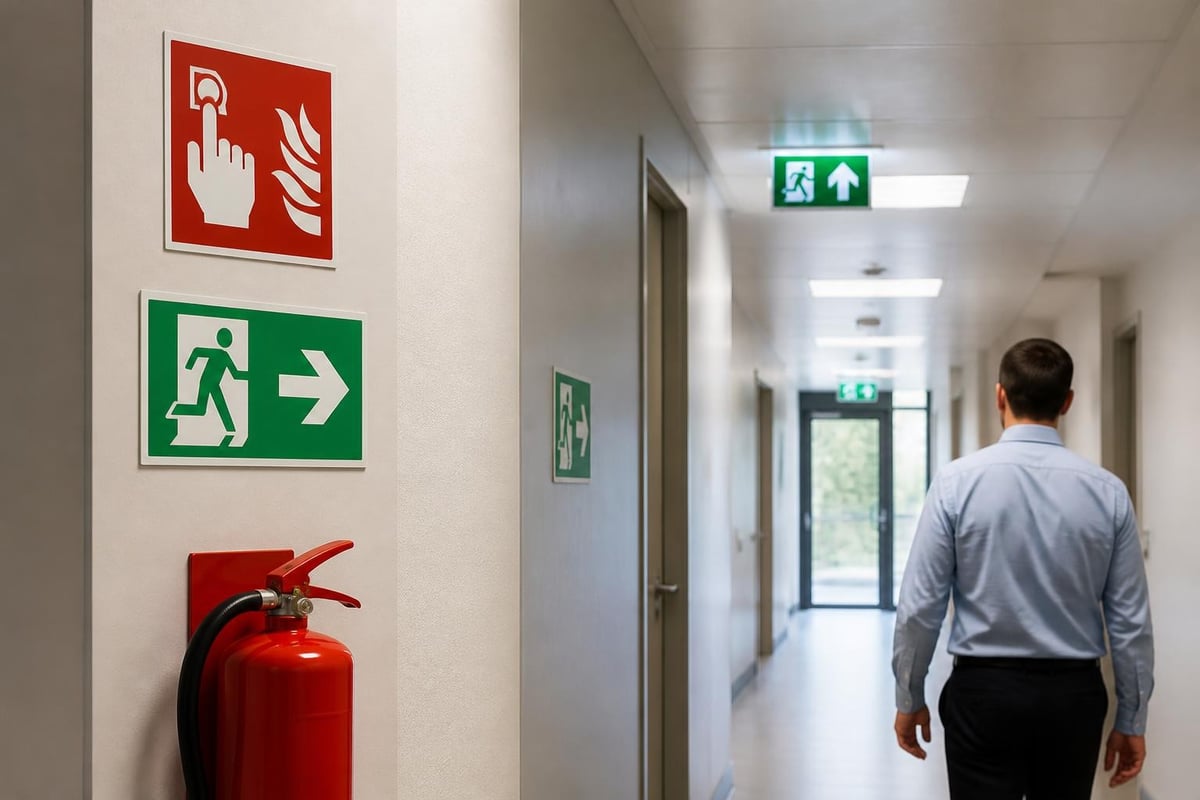
Exit signage must remain continuously visible and illuminated. Modern emergency lighting systems incorporate battery backup ensuring visibility during power failures. Photoluminescent materials offer an alternative, absorbing ambient light and glowing for hours in darkness.
Fire equipment signs identify the location of extinguishers, hoses, alarms, and suppression system controls. These signs must be positioned to remain visible from various approach angles, typically mounted above equipment or on adjacent walls.
Evacuation route signs guide building occupants to safety using directional arrows and running person symbols. These signs form a continuous path from any location to emergency exits, with spacing ensuring the next sign remains visible from each position.
Assembly Point Designation
External assembly points require clear marking to organize evacuees and facilitate headcounts. These signs must be visible from building exits and sufficiently large for recognition across outdoor distances. Weather resistance proves essential for these permanently exposed installations.
Industry-Specific Safety Signage Requirements
Different industries face unique hazards requiring specialized safety signage solutions. Manufacturing environments, construction sites, healthcare facilities, and retail spaces each demand tailored approaches.
Manufacturing facilities contend with machinery hazards, chemical exposures, and material handling risks. Safety signs in these environments must address:
- Lockout/tagout procedures for equipment maintenance
- Chemical hazard warnings with appropriate GHS pictograms
- Material flow directions and forklift traffic routes
- Personal protective equipment requirements for specific zones
Construction sites present dynamic hazards that change as projects progress. Temporary signage solutions allow flexibility whilst maintaining safety standards. High-visibility materials combat the dusty, challenging conditions typical of active construction.
Healthcare and Laboratory Settings
Medical facilities require safety signs addressing biological hazards, radiation risks, and medication storage requirements. These specialized signs often incorporate universal biohazard symbols and radiation trefoils alongside facility-specific information.
Laboratories utilize safety signs to delineate containment levels, chemical storage areas, and emergency equipment locations. The precision required in these environments demands clear, unambiguous signage that leaves no room for misinterpretation.
For facilities requiring sophisticated signage solutions, illuminated options provide enhanced visibility. Lightbox Signage manufactured with either Mae-West or acrylic returns offers excellent visibility in challenging lighting conditions, making them particularly suitable for 24-hour operations or environments where ambient lighting varies significantly.
Digital and Smart Safety Signage Solutions
Technology advancement has revolutionized safety communication through digital signage platforms. These systems offer dynamic messaging capabilities impossible with traditional static signs.
Digital safety displays can:
- Update automatically based on sensor inputs or facility conditions
- Display different messages for various shifts or operational states
- Integrate with building management systems for coordinated responses
- Provide real-time emergency instructions during evolving situations
Smart signage systems incorporate sensors detecting environmental conditions such as air quality, temperature, or gas concentrations. When thresholds exceed safe levels, the system automatically displays appropriate warnings and protective action instructions.
Emergency mass notification systems utilize digital displays to broadcast evacuation instructions, shelter-in-place orders, or all-clear messages. These systems prove invaluable during emergencies requiring coordinated facility-wide responses.
Integration with Safety Management Systems
Modern safety signage increasingly connects to broader safety management platforms. This integration enables centralized monitoring, automated compliance reporting, and data-driven optimization of sign placement and messaging.
Digital platforms track which signs attract attention, how long people view messages, and whether behavioral changes follow exposure. This data informs continuous improvement in safety communication effectiveness.
Cost Considerations and Return on Investment
Implementing comprehensive safety signage requires financial investment, yet the returns extend far beyond regulatory compliance. Proper safety signs reduce accident rates, minimize insurance claims, and demonstrate due diligence in protecting workers and visitors.
Material selection significantly impacts both initial costs and long-term value:
- Vinyl signs offer economy for indoor, temporary applications
- Aluminium composite provides durability for outdoor installations
- Stainless steel ensures longevity in corrosive environments
- Photoluminescent materials eliminate ongoing electricity costs
Volume requirements influence pricing structures. Organizations implementing facility-wide safety signage programmes typically achieve economies of scale unavailable for piecemeal purchases.
| Sign Type | Initial Cost | Lifespan | Maintenance | Best Application |
|---|---|---|---|---|
| Vinyl | Low | 2-3 years | Minimal | Indoor temporary |
| Aluminium | Medium | 7-10 years | Low | General outdoor |
| Stainless | High | 15+ years | Minimal | Harsh environments |
| Digital | Very High | 5-7 years | Moderate | Dynamic messaging |
Insurance and Liability Considerations
Inadequate safety signage exposes organizations to significant liability. Accidents occurring in areas lacking appropriate warnings can result in substantial compensation claims and regulatory penalties. Conversely, demonstrable investment in comprehensive safety signage strengthens defense positions and may reduce insurance premiums.
Documentation proving compliance with signage regulations provides crucial evidence during incident investigations. Maintaining records of sign installation dates, inspection schedules, and maintenance activities demonstrates organizational commitment to safety.
Sourcing and Customization Options
Selecting the right signage provider influences both quality outcomes and long-term satisfaction. Providers specializing in safety signage understand regulatory requirements and maintain current knowledge of standards updates.
Customization capabilities enable organizations to address unique hazards or incorporate corporate branding whilst maintaining safety communication effectiveness. Directional signs can be customized to guide people through complex facilities whilst incorporating facility-specific terminology and colour schemes.
Quality indicators when evaluating signage suppliers include:
- Demonstrated knowledge of relevant regulations and standards
- Material certifications and testing documentation
- Design capabilities including accessibility compliance
- Installation services and post-installation support
- Warranty coverage and replacement policies
Professional signage providers conduct site assessments, identifying optimal sign placements and recommending appropriate specifications. This consultative approach ensures comprehensive coverage rather than piecemeal solutions.
Training and Organizational Safety Culture
Safety signs represent just one component of effective safety communication. Their effectiveness multiplies when integrated into comprehensive training programmes and supported by strong safety cultures.
New employee inductions should include safety sign education, explaining the meaning of different sign types and appropriate responses. Regular refresher training ensures continued awareness, particularly when introducing new signage or relocating existing signs.
Behavioural observation reveals whether safety signs achieve their intended effects. If workers consistently ignore mandatory signs or fail to respond to warnings, investigation may reveal sign placement issues, design problems, or cultural factors undermining compliance.
Engaging workers in safety sign placement decisions improves buy-in and compliance. Frontline employees often identify hazards management overlooks and can suggest optimal sign locations based on their daily movement patterns.
Measuring Safety Signage Effectiveness
Quantifiable metrics enable organizations to assess signage programme success:
- Incident rates in signed versus unsigned areas
- Near-miss reporting frequency related to signed hazards
- Compliance observation scores during safety audits
- Employee comprehension testing results
- Visitor feedback on wayfinding and safety information clarity
Regular evaluation ensures safety signage continues meeting organizational needs as operations evolve. Periodic reviews identify opportunities for improvement, whether through new technologies, updated regulations, or lessons learned from incidents.
Effective safety signage protects lives, ensures regulatory compliance, and demonstrates organizational commitment to worker wellbeing. By understanding the categories, regulations, design principles, and strategic implementation approaches discussed throughout this guide, businesses can create comprehensive safety communication systems that truly safeguard their people. Whether you need standard compliance signs, specialized industrial warnings, or custom solutions addressing unique hazards, Signshoponline delivers professional signage solutions backed by expertise in safety communication and regulatory requirements. Contact our team today to discuss your safety signage needs and discover how proper sign implementation can transform your workplace safety culture.


