


Digital signage has evolved from simple static displays to sophisticated content delivery networks that power everything from retail environments to corporate communications. Among the platforms driving this transformation, digital signage Xibo stands out as an open-source solution that combines enterprise-grade features with unmatched flexibility. Originally developed by the University of London, Xibo has matured into a comprehensive content management system trusted by organisations worldwide to orchestrate dynamic visual communications across distributed screen networks. Whether you're managing a handful of displays in a single location or coordinating thousands of screens across multiple continents, understanding how digital signage Xibo operates can unlock significant advantages in both capability and cost-effectiveness.
Understanding the Xibo Architecture
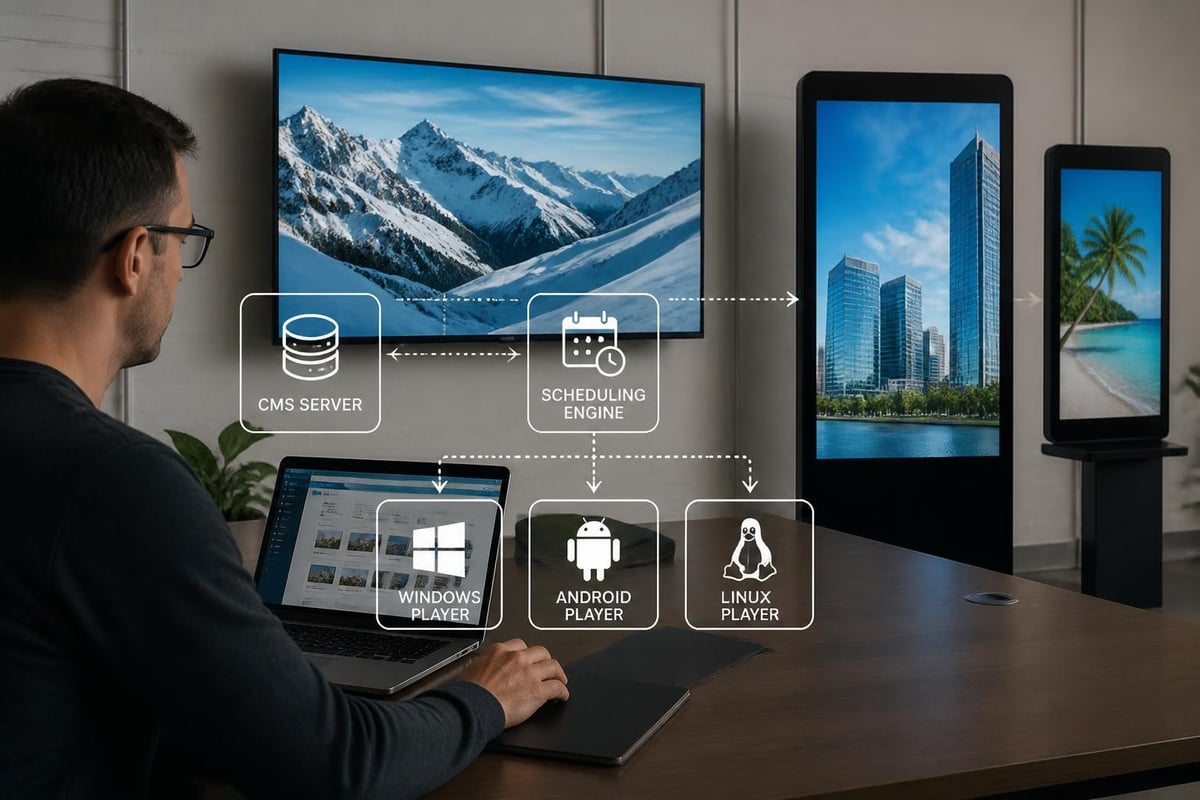
Digital signage Xibo operates through a client-server architecture that separates content management from playback responsibilities. The Xibo Content Management System (CMS) serves as the central hub where administrators design layouts, schedule content, organise media assets, and configure display settings. This web-based interface runs on standard server infrastructure, whether hosted on-premises or in cloud environments.
The player component runs on the display hardware itself, connecting to the CMS to retrieve scheduled content and playback instructions. Xibo supports multiple player platforms including Windows, Android, Linux, and webOS (for compatible LG displays). Each player maintains local caching of content, ensuring displays continue operating even during network interruptions.
System Components and Data Flow
The CMS database stores all configuration data, user permissions, scheduling information, and metadata about media files. Actual media assets (images, videos, documents) reside in a library folder structure, referenced by the database but maintained as separate files. This separation allows efficient backup strategies and scalability as libraries grow.
When a player connects, it requests its current schedule from the CMS. The server calculates which layouts should display based on dayparting rules, priority settings, and campaign schedules. Players download any new or updated media files, then execute the playback schedule autonomously. Status reports, proof-of-play logs, and screenshot captures flow back to the CMS for monitoring and compliance verification.
| Component | Function | Location |
|---|---|---|
| CMS Web Interface | Content creation, scheduling, management | Server (cloud or on-premises) |
| Database | Configuration, schedules, user data | Server alongside CMS |
| Media Library | Images, videos, files | Server storage/CDN |
| Player Software | Content playback, local caching | Display hardware |
| Display Module API | Third-party integrations | Server plugins |
Installation and Deployment Options
Modern digital signage Xibo deployments typically leverage Docker containerisation for simplified installation and maintenance. The Xibo for Docker installation guide provides comprehensive deployment instructions that bundle the CMS, database, and web server into orchestrated containers. This approach eliminates dependency conflicts and streamlines both initial setup and subsequent upgrades.
For organisations seeking minimal infrastructure overhead, Xibo offers cloud hosting through Xibo in the Cloud. This managed service handles server maintenance, security patches, backups, and scaling automatically. Cloud hosting particularly suits businesses deploying digital signage networks without dedicated IT infrastructure or those requiring rapid deployment timelines.
Self-Hosted Deployment Considerations
Self-hosted installations provide maximum control over data sovereignty, customisation depth, and integration with existing enterprise systems. Requirements include a Linux server (Ubuntu or CentOS recommended), MySQL or MariaDB database, PHP runtime, and adequate storage for media libraries. The official Xibo documentation details specific version requirements and optional dependencies.
Bandwidth planning becomes critical for distributed networks. Initial player setup requires downloading the full scheduled content library, potentially hundreds of gigabytes for video-heavy deployments. Ongoing traffic consists of schedule updates, new media files, and monitoring data. Content delivery networks (CDNs) can accelerate media distribution to geographically dispersed players, reducing load on the central CMS server.
Security hardening follows standard web application practices:
- HTTPS enforcement with valid SSL certificates for all CMS communications
- Strong authentication policies including password complexity and optional two-factor authentication
- Network segmentation isolating signage infrastructure from general corporate networks
- Regular patching of both Xibo software and underlying operating system components
- Access control limiting administrative privileges to authorised personnel only
The UK National Cyber Security Centre's security principles for connected infrastructure provide valuable guidance applicable to digital signage networks, particularly regarding authentication, encryption, and update mechanisms.
Content Creation and Layout Design
Digital signage Xibo employs a layout-based content model. Layouts serve as templates defining screen divisions (regions), each region containing a playlist of content items called widgets. A single layout might feature a news ticker across the bottom, weather information in the top corner, and rotating promotional content in the main area.
The layout designer provides drag-and-drop functionality for positioning regions and configuring their dimensions. Regions support various widget types including images, videos, embedded web pages, RSS feeds, clock displays, calendars, data visualisations from external sources, and custom HTML content. Each widget carries its own duration and transition settings, creating sophisticated multi-zone experiences from simple building blocks.
Media Library Management
Effective media library organisation becomes crucial as content volumes grow. Digital signage Xibo supports folder hierarchies, tagging systems, and metadata fields for categorising assets. Search and filter tools help content managers locate specific files within libraries containing thousands of items.
File format support spans common image formats (JPEG, PNG, GIF, BMP), video codecs (H.264, H.265, VP9), and document types (PDF, PowerPoint). The system automatically validates uploads against configured size limits and format restrictions. For video content, transcoding may be necessary to ensure playback compatibility across different player hardware capabilities.
Version control features track changes to layouts and media files. Administrators can review revision history and restore previous versions if needed. This proves particularly valuable in regulated environments where content approval workflows and audit trails are required.
Scheduling and Campaign Management
The scheduling engine represents one of digital signage Xibo's most powerful capabilities. Rather than manually switching content on each screen, administrators define schedules that automatically control what displays when, where, and under what conditions.

Dayparting and Priority Systems
Dayparting divides the broadcast day into segments, each assigned specific content. A retail environment might schedule product promotions during peak shopping hours, brand messaging during quieter periods, and internal communications before opening. The Xibo documentation hub provides detailed examples of complex scheduling scenarios and priority resolution rules.
Priority levels determine which content displays when schedules overlap. Emergency messaging can override all regular programming by setting maximum priority. Standard campaigns operate at medium priority, while default content serves as the fallback when nothing else is scheduled. This hierarchy ensures critical communications always reach audiences regardless of pre-existing schedules.
Campaigns group related layouts and schedules into logical units. A seasonal promotion campaign might include multiple layouts showcasing different products, scheduled across various display groups, with coordinated start and end dates. Campaign-level controls simplify managing complex multi-screen initiatives.
Display Groups and Targeting
Display groups organise screens into logical collections for targeted content delivery. Groups might represent physical locations (Store A, Store B), functional areas (Entrance displays, Product zones), or content types (Food promotions, Brand messaging). Hierarchical group structures allow granular targeting while maintaining management efficiency.
Geo-scheduling extends targeting based on time zones. International deployments can schedule region-appropriate content that aligns with local business hours rather than headquarter time zones. This proves essential for organisations operating across multiple continents.
Player Configuration and Hardware Integration
Digital signage Xibo players support diverse hardware platforms, each with specific strengths and deployment considerations. Windows players offer broad hardware compatibility and support for complex interactive features. Android players provide cost-effective options with low power consumption, ideal for basic content playback. Linux players suit custom hardware configurations and embedded applications.
Display module integration extends Xibo's capabilities through standardised APIs. Modules can control display power states, adjust brightness based on ambient lighting, or integrate with building automation systems. The open-source nature of Xibo enables custom module development for organisation-specific requirements.
For environments requiring additional visual impact beyond standard digital displays, complementary signage solutions enhance overall communications. Lightbox signage combines traditional illuminated displays with digital content management, creating hybrid installations where scheduled digital content appears alongside static illuminated graphics for maximum visual prominence.

Network Connectivity and Offline Operation
Players maintain local content caches enabling continued operation during network outages. When connectivity restores, players synchronise with the CMS to retrieve schedule updates and new media files. This architecture ensures display continuity even in environments with unreliable networking infrastructure.
Bandwidth optimisation features include content pre-downloading during off-peak hours, delta-sync protocols that transfer only changed file portions, and configurable update windows preventing network saturation during business hours. These mechanisms allow digital signage Xibo deployments to coexist peacefully with other network services.
Advanced Features and Integrations
Data integration capabilities allow digital signage Xibo to display live information from external sources. Database connectors can pull sales figures, production metrics, or customer queue lengths into display layouts. RSS and API widgets fetch news feeds, weather forecasts, social media streams, or custom data endpoints. This transforms static screens into dynamic information radiators reflecting real-time organisational activity.
Interactive features enable audience engagement through touch displays, mobile integration, or sensor inputs. Touch-enabled layouts respond to user interactions, presenting wayfinding information, product catalogues, or service directories. QR code widgets bridge physical and digital experiences, allowing viewers to transfer content from public displays to personal devices.
| Feature Category | Capabilities | Business Applications |
|---|---|---|
| Data Integration | Database queries, API calls, RSS feeds | Real-time metrics, news, social media |
| Interactivity | Touch response, mobile pairing, sensors | Wayfinding, product information, engagement |
| Proof of Play | Screenshot capture, playback logging | Compliance verification, advertising validation |
| Remote Management | Display control, player diagnostics | Distributed network administration |
| Multi-user | Role-based permissions, workflow approvals | Enterprise governance, content approval |
Proof-of-play reporting generates compliance documentation verifying content aired as scheduled. Screenshots captured at configurable intervals provide visual evidence of actual playback. Log files record every layout transition with timestamp accuracy. These features serve advertising compliance requirements and internal audit needs.
Open-Source Advantages and Community
The open-source foundation of digital signage Xibo delivers multiple strategic advantages. Source code transparency allows security audits, custom feature development, and integration with proprietary systems. The GitHub repository hosts the complete codebase, enabling organisations to verify exactly how their signage infrastructure operates.
Community contributions drive continuous platform evolution. Developers worldwide contribute modules, translations, bug fixes, and feature enhancements. This collaborative model accelerates innovation beyond what any single vendor could achieve independently. The Xibo community forums provide peer support, implementation guidance, and knowledge sharing among thousands of deployment professionals.
Licensing and Cost Considerations
Xibo's AGPLv3 license permits free use, modification, and distribution for self-hosted deployments. Organisations pay nothing for the software itself, investing instead in infrastructure, customisation, and support. This licensing model eliminates per-screen fees common with proprietary platforms, dramatically reducing total cost of ownership for large-scale deployments.
Commercial support packages and cloud hosting services provide options for organisations preferring vendor-backed solutions. These services fund ongoing platform development while maintaining the core software's open-source status. This hybrid model balances community innovation with enterprise support requirements.
Privacy and Compliance Frameworks
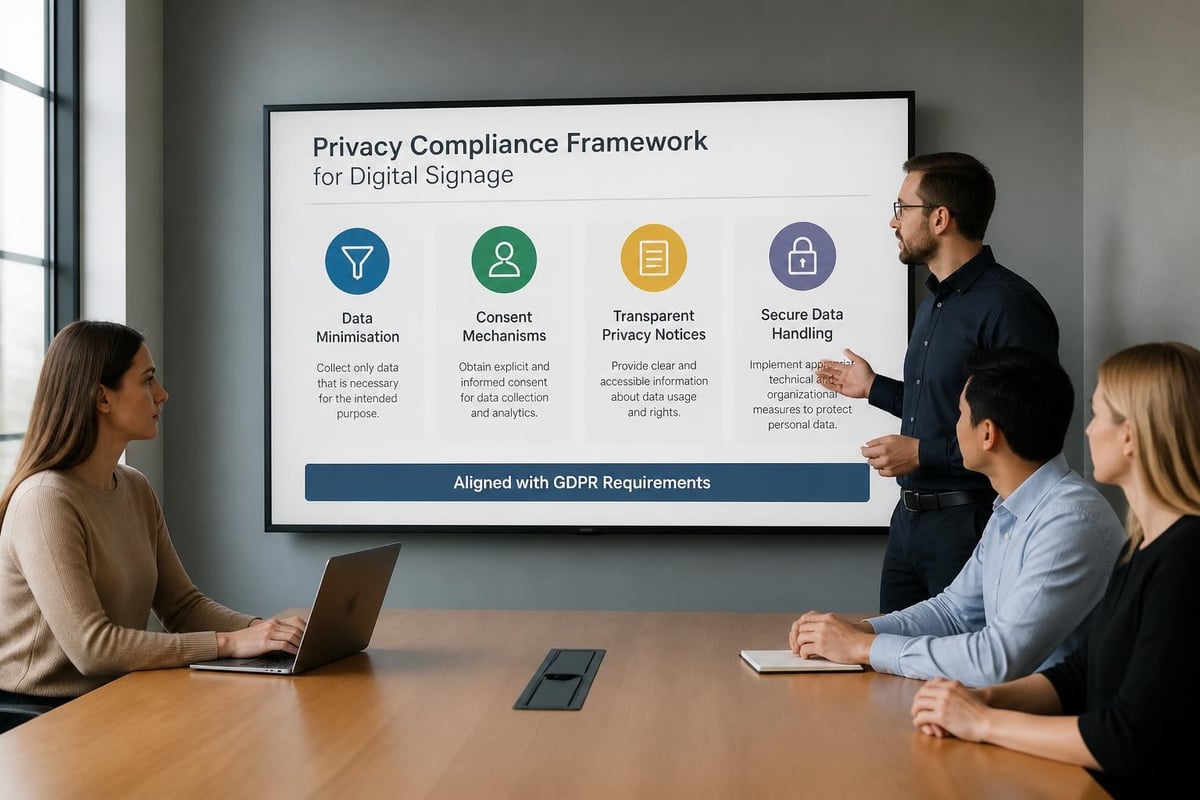
Digital signage deployments increasingly raise privacy considerations, particularly when incorporating cameras, audience analytics, or personal data displays. The World Privacy Forum's privacy principles for digital signage provide guidance on transparent data practices, consent mechanisms, and privacy-preserving design patterns.
GDPR compliance requires careful attention when signage systems process personal information or track individuals. Privacy impact assessments should precede deployments incorporating facial recognition, dwell-time analytics, or personalised messaging. Clear signage informing audiences about data collection, purpose limitations, and data subject rights form essential compliance elements.
Security practices extend beyond network protection to address the entire deployment lifecycle. The IoT Security Foundation's vulnerability disclosure research highlights the importance of coordinated disclosure processes and timely patch management for connected devices, directly applicable to digital signage player security.
Real-World Implementation Examples
Industry case studies demonstrate digital signage Xibo's versatility across sectors. The Blue Billboard deployment documented by Digital Signage Today showcases large-scale network expansion using Xibo CMS coordinating Sony BRAVIA professional displays. This implementation highlights how open-source platforms integrate with premium display hardware to deliver enterprise-grade results.
Retail environments leverage digital signage Xibo for promotional content rotation, dynamic pricing displays, and customer experience enhancement. Restaurants deploy menu boards with real-time inventory integration, automatically removing sold-out items from display. Corporate offices use signage networks for internal communications, meeting room booking displays, and employee recognition programmes.
Educational institutions implement campus-wide information systems displaying schedules, emergency alerts, and wayfinding information. Healthcare facilities coordinate patient information displays, queue management systems, and departmental directories. Transportation hubs manage arrival/departure boards, advertising space, and passenger information displays through unified Xibo deployments.
Standards Compliance and Interoperability
Web standards adoption ensures digital signage Xibo remains compatible with evolving technologies and content formats. The W3C's web-based signage architecture specifications define interoperability requirements for storage, playback, and content exchange. Xibo's HTML-based content engine aligns with these standards, supporting modern web technologies including HTML5, CSS3, and JavaScript.
API-first design enables integration with external systems through documented REST endpoints. Third-party applications can programmatically manage content, update schedules, retrieve playback statistics, and control displays. This openness supports ecosystem development around the core platform, with specialised tools addressing industry-specific requirements.
Content portability considerations affect long-term platform sustainability. Digital signage Xibo's use of standard media formats and documented data structures facilitates migration scenarios. Organisations avoid vendor lock-in associated with proprietary content formats and closed ecosystems.
Performance Optimisation Strategies
Network performance directly impacts digital signage Xibo deployment quality. Content pre-caching, intelligent bandwidth management, and CDN integration minimise playback interruptions. Monitoring tools track player connectivity, content synchronisation status, and playback failures across the entire network.
Display hardware selection balances cost against performance requirements. High-resolution video playback demands capable processors and adequate memory. Simple image rotation functions adequately on minimal specifications. Matching hardware capabilities to content complexity optimises both quality and cost-effectiveness.
Database optimisation becomes critical as deployments scale. Indexing strategies, query optimisation, and regular maintenance prevent performance degradation as content libraries and user bases grow. For very large installations, database clustering and load balancing distribute processing loads across multiple servers.
Future Developments and Roadmap
The digital signage industry continues evolving, with emerging technologies influencing platform development. Artificial intelligence integration enables content personalisation based on audience analytics, automated scheduling optimisation, and predictive maintenance. Edge computing pushes processing closer to displays, reducing latency and enabling more sophisticated local interactions.
Sustainability considerations drive energy-efficient display technologies and optimised content delivery reducing bandwidth consumption. Carbon footprint awareness influences hardware selection, with low-power players and displays gaining preference. Circular economy principles encourage equipment lifecycle extension through software updates rather than hardware replacement.
The academic research on digital privacy examines emerging privacy challenges as displays become increasingly intelligent and connected. Future developments must balance enhanced capabilities with robust privacy protections, transparent data practices, and ethical deployment frameworks.
Digital signage Xibo provides organisations with a powerful, flexible platform for visual communications that scales from single displays to global networks without licensing constraints that burden proprietary alternatives. The combination of open-source transparency, enterprise features, and community-driven innovation creates a compelling value proposition for businesses investing in digital signage infrastructure. Whether you're exploring digital signage for the first time or seeking to migrate from existing systems, Signshoponline delivers comprehensive signage solutions spanning traditional and digital platforms, helping you create impactful visual communications tailored to your specific business requirements.


