


Fire safety equipment saves lives, but only when people can find it quickly during emergencies. Clear, compliant fire extinguisher signage ensures that building occupants can locate firefighting equipment within seconds, making the difference between containing a small fire and facing catastrophic damage. In 2026, workplace safety regulations across multiple jurisdictions continue to emphasize the critical role of proper identification and marking systems for fire protection equipment. Whether you manage a commercial office, retail space, warehouse, or industrial facility, understanding the requirements and best practices for fire extinguisher signage protects both your people and your property.
Regulatory Framework for Fire Extinguisher Signage
Fire extinguisher signage requirements vary by jurisdiction, but most developed nations follow similar principles rooted in international safety standards. The NFPA 10 standard provides comprehensive guidance on portable fire extinguisher selection, installation, inspection, and maintenance, including specific requirements for identification markers.
In the United Kingdom, fire safety risk assessments for workplaces must include proper identification of fire-fighting equipment. The UK Government's fire safety guidance for offices and shops emphasizes that fire extinguishers must be clearly marked with standardized pictograms and positioned so that signage remains visible from normal approach routes.
European Union Standards
The European Union's approach to fire safety signage falls under the broader occupational health and safety framework. EU Directive 92/58/EEC establishes minimum requirements for safety signage at workplaces, including specific provisions for fire-fighting equipment identification. This directive mandates:
- Standardized pictograms showing a white flame symbol on a red background
- Directional arrows where fire extinguishers are not immediately visible
- Photoluminescent or illuminated signs in areas with poor lighting
- Consistent color coding across all safety signage
Key Regulatory Elements
Most jurisdictions require fire extinguisher signage to meet several fundamental criteria:
- High visibility: Signs must be clearly visible from normal walking routes
- Standardized symbols: Internationally recognized pictograms ensure universal understanding
- Height requirements: Mounting specifications ensure signs remain visible above crowds
- Photoluminescence: Many codes require glow-in-the-dark properties for emergency visibility
- Durability: Materials must withstand environmental conditions without fading or deterioration
Types of Fire Extinguisher Signage
Different building layouts and occupancy types require various signage solutions to ensure fire extinguishers remain identifiable under all circumstances. Understanding the distinct categories helps facility managers select appropriate markers for each location.
Wall-Mounted Identification Signs
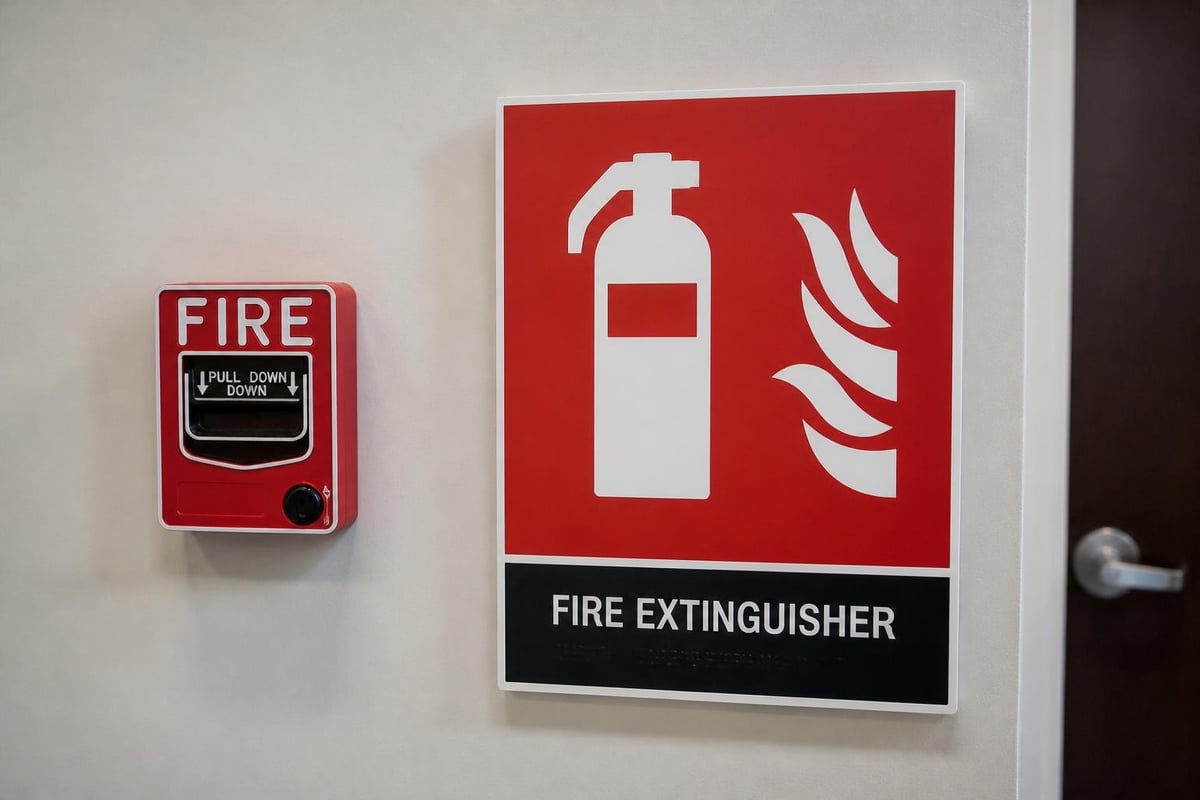
The most common form of fire extinguisher signage attaches directly to walls above or beside the equipment. These signs typically measure between 200mm and 300mm square, featuring bold red backgrounds with white pictograms. Modern designs incorporate photoluminescent materials that absorb ambient light and glow for several hours during power failures.
Standard wall-mounted signs display a simple flame symbol to indicate fire-fighting equipment. More detailed versions include text indicating the extinguisher type (water, foam, CO2, dry powder) and applicable fire classes. Many facilities utilizing products from Signshoponline choose custom wall signage that matches their overall wayfinding system whilst maintaining regulatory compliance.
Directional and Suspended Signs
In large open spaces, warehouses, or facilities where fire extinguishers cannot be positioned along main corridors, directional signage becomes essential. These markers feature arrows pointing toward the nearest equipment, often incorporating distance information to guide users efficiently.
Suspended ceiling-mounted signs provide 360-degree visibility in areas with high shelving, machinery, or other obstructions. These double-sided markers hang perpendicular to walls, ensuring visibility from multiple approach angles. Flag-style signs that project from walls serve similar purposes in corridors where line-of-sight may be blocked.
| Sign Type | Best Application | Typical Size | Key Features |
|---|---|---|---|
| Wall-mounted | Standard installations | 200-300mm square | Direct equipment identification |
| Directional | Large open areas | 150-400mm | Arrows with distance markers |
| Suspended | High-bay facilities | 300-600mm | Dual-sided, 360° visibility |
| Floor markers | Low-light areas | 300-450mm diameter | Photoluminescent, slip-resistant |
Photoluminescent Technology
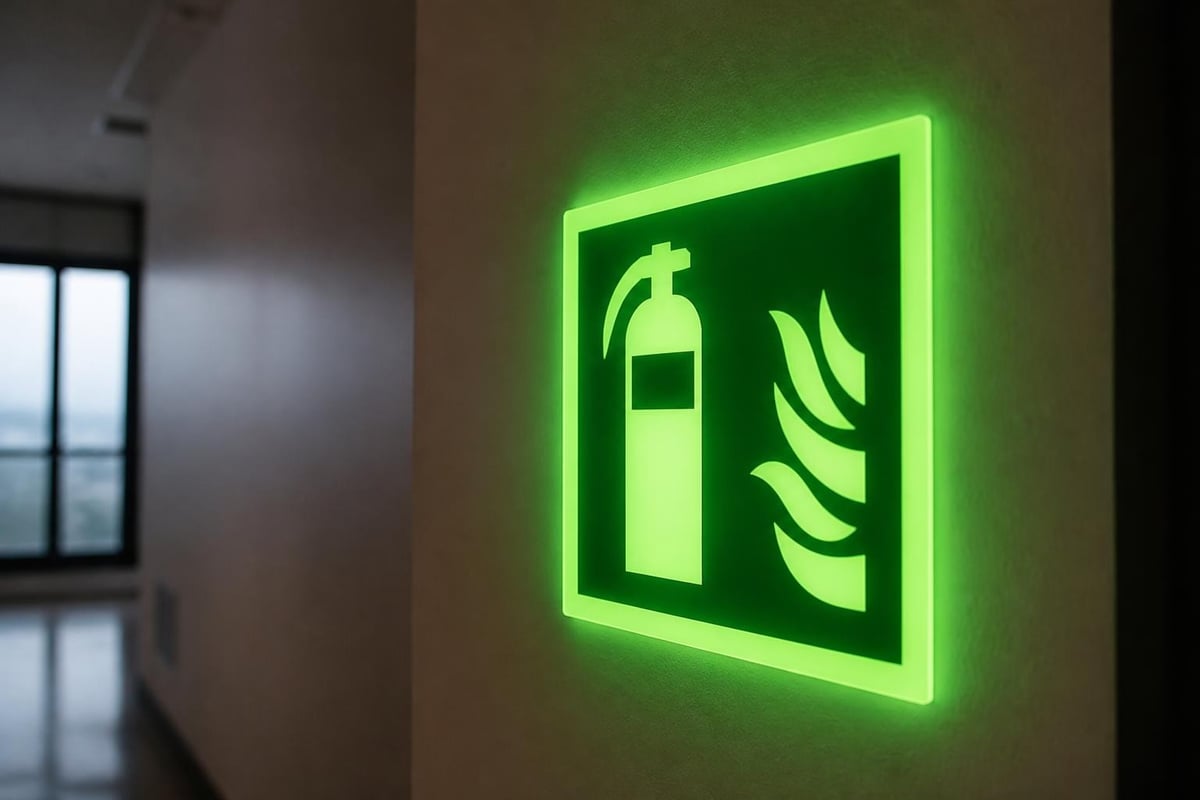
Photoluminescent fire extinguisher signage represents a critical safety advancement, particularly valuable during power failures when artificial lighting fails. These signs absorb and store energy from ambient light sources, then emit a visible glow for several hours in darkness.
Modern photoluminescent materials far exceed earlier glow-in-the-dark technologies in both brightness and duration. Quality signage maintains visibility for 8-12 hours after light exposure ceases, ensuring emergency equipment remains locatable throughout overnight periods or extended power outages. Many building codes now mandate photoluminescent properties for all fire safety signage installed after 2020.
Design Standards and Specifications
Effective fire extinguisher signage balances regulatory compliance with practical visibility requirements. The design process must consider viewing distances, ambient lighting conditions, and potential obstructions that could compromise sign effectiveness.
Color and Contrast Requirements
Red serves as the universal color for fire equipment identification, with white symbols and text providing maximum contrast. British Standards specify Pantone 485C or RAL 3001 for red backgrounds, ensuring consistency across installations. The white elements must maintain a minimum contrast ratio of 10:1 against the red field for optimal visibility.
Some facilities supplement standard red-and-white signage with green "fire exit" markers incorporating fire extinguisher locations. Whilst this approach provides additional wayfinding context, it must not replace dedicated equipment identification signs that comply with primary standards.
Size and Viewing Distance Calculations
Sign sizing directly correlates with expected viewing distances. The general formula suggests 25mm of sign height per metre of viewing distance. For a fire extinguisher that must be identifiable from 10 metres away, the sign should measure at least 250mm in height.
Recommended sign sizes for common applications:
- Small offices (3-5m viewing distance): 150-200mm
- Retail spaces (5-8m viewing distance): 200-250mm
- Warehouses (10-15m viewing distance): 300-400mm
- Industrial facilities (15-20m viewing distance): 400-600mm
Material Selection and Durability
Fire extinguisher signage must withstand various environmental challenges whilst maintaining visibility over extended periods. Material choices significantly impact longevity and performance.
Rigid substrates such as aluminium composite panels, rigid PVC, or acrylic provide excellent durability for permanent installations. These materials resist warping, fading, and physical damage better than flexible alternatives. Self-adhesive vinyl signs offer economical solutions for temporary or frequently changed locations, though they require more frequent replacement.
External applications demand weatherproof materials with UV-resistant inks or substrates. Coastal environments require additional corrosion resistance, whilst industrial settings may need chemical-resistant coatings. For businesses seeking durable, professional signage solutions, industrial signs designed for harsh environments ensure long-term compliance.
Installation Best Practices
Proper installation maximizes fire extinguisher signage effectiveness regardless of design quality. Mounting height, positioning, and environmental considerations all influence whether occupants can quickly locate equipment during emergencies.
Height and Placement Standards
The U.S. Fire Administration recommends mounting fire extinguisher signage at a height of 1.8-2.1 metres (6-7 feet) from the finished floor to the bottom of the sign. This elevation ensures visibility above typical crowd heights and furniture whilst remaining low enough to read clearly.
Signs must be positioned directly above fire extinguishers when wall-mounting is feasible. Where cabinets or recessed installations house equipment, signage should be centered above the access point. In situations where wall-mounted signs prove inadequate due to obstructions or layout constraints, supplementary directional or suspended signs create clear visual pathways.
Avoiding Common Installation Mistakes
Several installation errors compromise fire extinguisher signage effectiveness despite regulatory compliance on paper:
- Placing signs behind doors that swing open
- Mounting signs where shelving or equipment blocks sightlines
- Installing inadequately sized markers for the viewing distance
- Failing to illuminate or provide photoluminescent properties in poorly lit areas
- Using decorative elements that obscure required pictograms
Regular walkthroughs from various approach angles help identify potential visibility issues before emergencies arise. Simulating smoke conditions with theatrical fog can reveal unexpected sight-line problems that normal lighting conditions mask.
Integration with Overall Wayfinding Systems
Fire extinguisher signage functions most effectively when integrated into comprehensive wayfinding systems. Consistent design languages, color schemes, and mounting heights create intuitive navigation that building occupants absorb subconsciously over time.
Facilities incorporating directional signs for general wayfinding benefit from unified visual systems where fire safety markers complement rather than clash with other signage. This integration proves particularly valuable in complex buildings where visitors unfamiliar with layouts must locate safety equipment quickly.
Maintenance and Compliance Monitoring
Installing compliant fire extinguisher signage represents only the initial step in an ongoing safety program. Regular inspections, cleaning, and replacement cycles ensure markers maintain effectiveness throughout their service life.
Inspection Schedules and Documentation
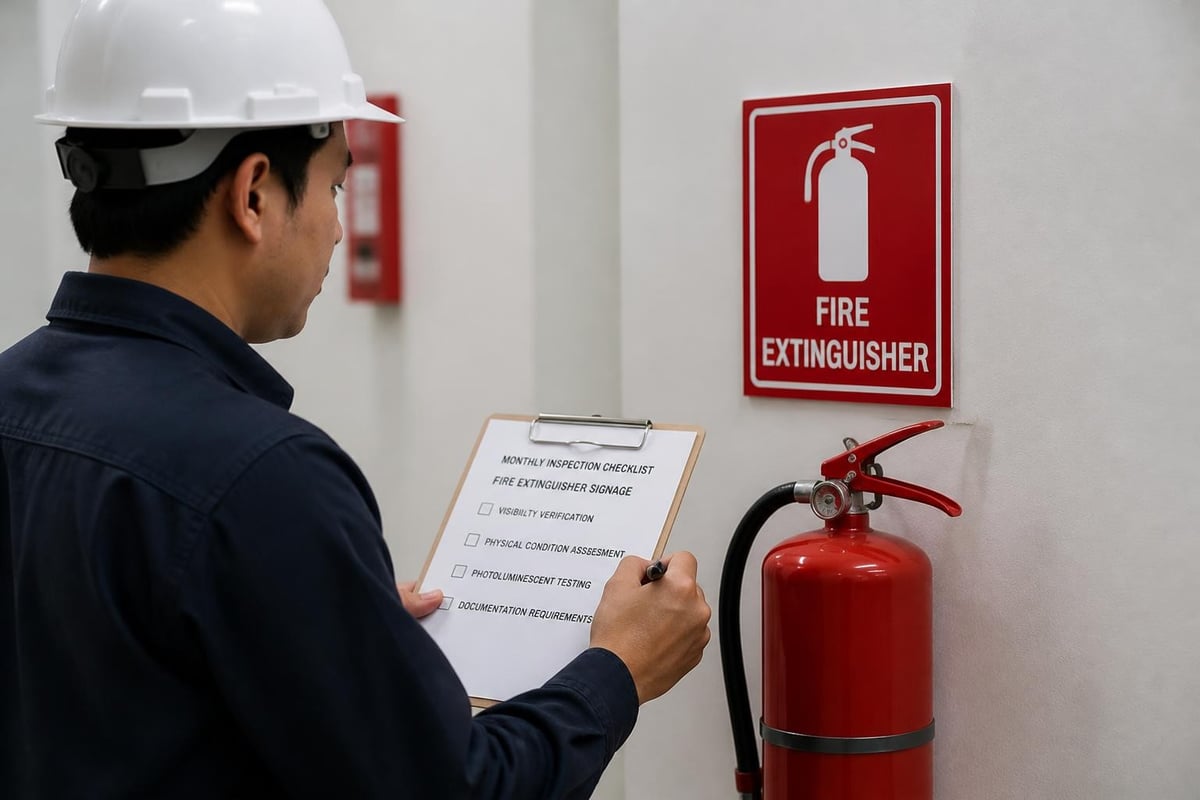
Fire safety regulations typically mandate monthly visual inspections of fire extinguishers, creating natural opportunities to assess associated signage condition. Inspectors should verify that signs remain:
- Visible from normal approach routes
- Clean and free from damage or obstruction
- Properly illuminated or photoluminescent-charged where required
- Securely mounted with no sagging or deterioration
- Consistent with current regulatory standards
Documentation systems should track signage condition alongside equipment maintenance records. Photograph documentation proves particularly valuable for demonstrating compliance during official inspections and identifying degradation trends that suggest premature replacement needs.
Common Wear Factors and Solutions
Different environments impose varying stress on fire extinguisher signage materials:
| Environment | Primary Challenge | Recommended Solution |
|---|---|---|
| High-traffic areas | Physical damage | Impact-resistant substrates, protective overlaminates |
| Outdoor installations | UV degradation | UV-stabilized materials, routine replacement cycles |
| Industrial facilities | Chemical exposure | Chemically-resistant coatings, sealed edge construction |
| Coastal locations | Corrosion | Stainless steel or non-metallic substrates |
Establishing proactive replacement schedules based on environmental factors prevents signage from deteriorating to the point of non-compliance. Most quality fire extinguisher signage should last 5-7 years in indoor environments and 3-5 years in outdoor or harsh conditions.
Advanced Signage Solutions for Complex Environments
Certain occupancies present unique challenges requiring specialized fire extinguisher signage approaches beyond standard wall-mounted markers. Healthcare facilities, educational institutions, and large public venues demand enhanced solutions.
Illuminated and Digital Options
Traditional photoluminescent signage excels in most applications, but some environments benefit from active illumination. Healthcare facilities operating 24-hour schedules in dimly lit corridors often specify internally illuminated fire extinguisher signs. Illuminated lightbox signage provides consistent visibility regardless of ambient conditions whilst consuming minimal energy through LED technology.
For maximum impact and regulatory compliance, facilities can invest in professionally manufactured Lightbox Signage that combines fire safety symbols with edge-lit or back-lit illumination, ensuring equipment remains visible even during smoke conditions when photoluminescence alone might prove insufficient.
Digital signage networks in modern buildings increasingly incorporate fire safety information, though regulations prohibit relying solely on electronic systems for life-safety marking. Dynamic displays supplement rather than replace physical signage, providing multilingual information, equipment status updates, and emergency procedure reminders during normal operations.
Multilingual and Pictogram-Only Approaches
International pictograms minimize language barriers in diverse workplaces, tourist venues, and transportation facilities. Pure symbol-based fire extinguisher signage communicates equipment location universally without requiring text comprehension. The ISO 7010 standard provides globally recognized symbols specifically designed for this purpose.
Facilities serving multilingual populations may supplement standard pictograms with text in two or three languages, though excessive text can reduce symbol size and compromise distant visibility. Designers must balance inclusivity with the fundamental requirement that signs remain readable from specified distances.
Accessibility Considerations
Fire safety must serve all building occupants, including those with visual or mobility impairments. Tactile signage incorporating raised symbols and Braille text assists visually impaired individuals in locating fire-fighting equipment. These markers typically mount at lower heights (900-1200mm) than standard identification signs to accommodate wheelchair users and conform to requirements outlined in accessibility signs standards.
Audible alarm systems that announce fire extinguisher locations during emergencies represent cutting-edge accessibility features, though few jurisdictions currently mandate such technology. Forward-thinking facility managers incorporate these systems voluntarily to ensure comprehensive safety coverage.
Coordinating Fire Safety Signage with Other Systems
Fire extinguisher markers function within broader safety signage ecosystems that include emergency exit indicators, assembly point markers, and evacuation route maps. Coordination across these systems creates intuitive, cohesive safety environments.
Color-Coding and Visual Hierarchy
Safety signage color standards establish instant recognition patterns. Red indicates fire equipment, green marks exits and safety zones, yellow signals caution, and blue denotes mandatory actions. Maintaining strict color discipline prevents confusion during high-stress emergencies when cognitive processing slows significantly.
Visual hierarchy principles ensure that fire extinguisher signage commands appropriate attention without overwhelming more critical exit markers. Exit signs typically maintain primacy in safety signage systems, with equipment identification markers sized and positioned to provide secondary support information.
Integration with Building Management Systems
Modern building management systems (BMS) increasingly track fire safety equipment status electronically, monitoring cabinet access, extinguisher pressure, and inspection schedules. Smart signage solutions incorporate status indicators that alert facility managers to maintenance needs or equipment removal.
QR codes embedded in fire extinguisher signage link to digital inspection records, equipment specifications, and usage instructions. Whilst regulatory compliance still requires physical identification markers, these digital enhancements provide valuable supplementary information for training, maintenance, and emergency response planning.
Training and Cultural Integration
The most sophisticated fire extinguisher signage systems fail if building occupants don't understand their purpose or incorporate safety awareness into daily routines. Effective fire safety programs combine compliant signage with comprehensive training and organizational culture development.
Employee Orientation Programs
New employee orientation provides ideal opportunities to familiarize staff with fire extinguisher locations and signage systems. Walking tours that physically visit each fire-fighting equipment location create stronger mental maps than classroom presentations alone. Interactive exercises where participants locate nearest extinguishers from various workstations reinforce learning through practice.
Regular refresher training maintains awareness as workplace layouts evolve and staff turnover introduces new team members. Annual fire drills should incorporate equipment location exercises alongside evacuation procedures, ensuring everyone can find extinguishers quickly under realistic conditions.
Public Awareness in Customer-Facing Spaces
Retail environments, hospitality venues, and public buildings house substantial numbers of visitors unfamiliar with facility layouts. Enhanced fire extinguisher signage in these settings compensates for occupants' limited building knowledge.
Clear sight-lines from main entrances to nearest fire equipment, supplemented by retail signs that subtly incorporate safety information into general wayfinding systems, create safer environments without compromising aesthetic appeal. Premium hospitality venues often specify custom-designed fire safety markers that maintain brand consistency whilst meeting all regulatory requirements.
Procurement and Specification Considerations
Purchasing fire extinguisher signage requires balancing compliance requirements, durability needs, budget constraints, and aesthetic preferences. Systematic specification processes ensure installations meet all critical criteria whilst avoiding costly mistakes.
Writing Effective Signage Specifications
Comprehensive specifications document all requirements clearly, eliminating ambiguity that leads to non-compliant installations or excessive costs. Effective fire extinguisher signage specifications should address:
- Regulatory compliance: Specific standards and codes that apply to the jurisdiction
- Material requirements: Substrate type, thickness, and environmental resistance
- Dimensional specifications: Height, width, and viewing distance calculations
- Color standards: Pantone or RAL references for precise color matching
- Photoluminescent properties: Glow duration and brightness specifications
- Mounting methods: Hardware types and installation requirements
- Warranty terms: Expected service life and replacement provisions
Partnering with experienced signage manufacturers who understand fire safety requirements streamlines the specification process. Firms like Signshoponline bring deep expertise in regulatory compliance across product lines, helping clients navigate complex requirements whilst achieving cost-effective solutions.
Budget Planning and Life-Cycle Costs
Initial purchase prices represent only one component of total ownership costs. Durable materials commanding higher upfront investments often deliver superior long-term value through extended service life and reduced maintenance requirements.
Life-cycle cost comparison factors:
- Initial material and installation costs
- Expected service life before replacement
- Maintenance and cleaning requirements
- Compliance risk and potential citation costs
- Energy consumption for illuminated options
- Replacement labor and disruption costs
Facilities managing large extinguisher inventories benefit from standardizing on consistent signage solutions that simplify reordering, installation, and maintenance. Volume purchasing agreements and scheduled replacement programs further optimize costs whilst ensuring compliance continuity.
Properly specified and maintained fire extinguisher signage represents a fundamental component of workplace safety that protects lives whilst demonstrating regulatory compliance. By understanding current standards, selecting appropriate materials, and integrating fire safety markers into comprehensive wayfinding systems, facility managers create safer environments for employees, customers, and visitors. Whether you need compliant safety signage, professional door signs, or comprehensive facility marking solutions, Signshoponline delivers quality products backed by expertise in regulatory requirements and practical implementation across diverse environments.


